

A quote sitting in an inbox for two days is not an administrative delay. It is a revenue risk, a customer experience problem and, often, a sign that commercial authority is unclear. Knowing how to automate quote approvals means designing a faster route to a decision without allowing discounting, margins or contractual terms to slip outside policy.
The goal is not to remove people from every approval. It is to remove unnecessary waiting, duplicate checking and manual chasing. A well-designed approval route lets low-risk quotes move quickly, directs exceptions to the right person and records why each decision was made.
Why quote approvals become a bottleneck
Most approval processes begin with sensible intent. A sales manager wants visibility over discounting. Finance wants to protect margin. Delivery teams need to confirm capacity, and senior leaders may need to approve non-standard terms. The difficulty arrives when these checks live in email threads, spreadsheets, chat messages and individual memory.
A salesperson may know that a 10 per cent discount is usually acceptable, but not whether it applies to a particular product line, customer tier or project type. An approver may receive a quote with no context on historic pricing, payment terms or delivery commitments. The result is a familiar pattern: follow-ups, rework and quotes that expire before a clear answer arrives.
Automation addresses the route, not just the notification. It connects quote data to the policies and business context that determine who needs to decide what.
How to automate quote approvals with control
Start by mapping the decision boundaries already present in the business. Do not begin with a workflow tool or an AI assistant. Begin with the actual questions that make a quote safe to send: What discount is proposed? Does the margin meet the threshold? Are the payment terms standard? Is the scope within delivery capacity? Is the customer an existing account with an agreed rate card?
From there, define which outcomes can be approved automatically, which require a named role and which must stop for senior review. This is the difference between automation and uncontrolled delegation.
For example, a professional services firm might allow quotes under $15,000 to proceed automatically where the customer is existing, the rate card is followed and the gross margin exceeds the agreed floor. A quote with a reduced day rate, extended payment terms or a new liability clause should be routed to the appropriate commercial or executive approver. The system should explain the reason for that route in plain language.
The rules will vary by industry and risk appetite. A field service operator may need a capacity check before approving a large maintenance proposal. A healthcare administration provider may require extra scrutiny where services involve regulated information or non-standard data handling. The useful principle is consistent: automate repeatable judgement within defined authority, then preserve human ownership at consequential boundaries.
Build the approval route around reliable data
An approval workflow is only as trustworthy as the information it receives. If sales staff must manually re-enter customer details, pricing, cost assumptions and terms into a separate approval form, the process will remain slow and error-prone.
The stronger model captures quote information in the CRM, quoting platform or ERP where the work begins. It then pulls the relevant context from connected systems. That may include the customer’s payment history, current contract, approved price book, project pipeline, technician availability or account risk status.
This does not mean every system needs to be replaced. Many businesses already have the components required: a CRM, accounting or ERP platform, document repository, inbox and team collaboration tool. The implementation work is in connecting them into a governed operational route.
At minimum, the workflow should validate the customer record, quote value, discount, expected margin, payment terms, expiry date and scope category. Where possible, it should calculate those fields from source data rather than ask staff to interpret them manually. If the data is incomplete, the quote should return to the owner with a specific request, not disappear into a generic rejection queue.
Set approval thresholds people can understand
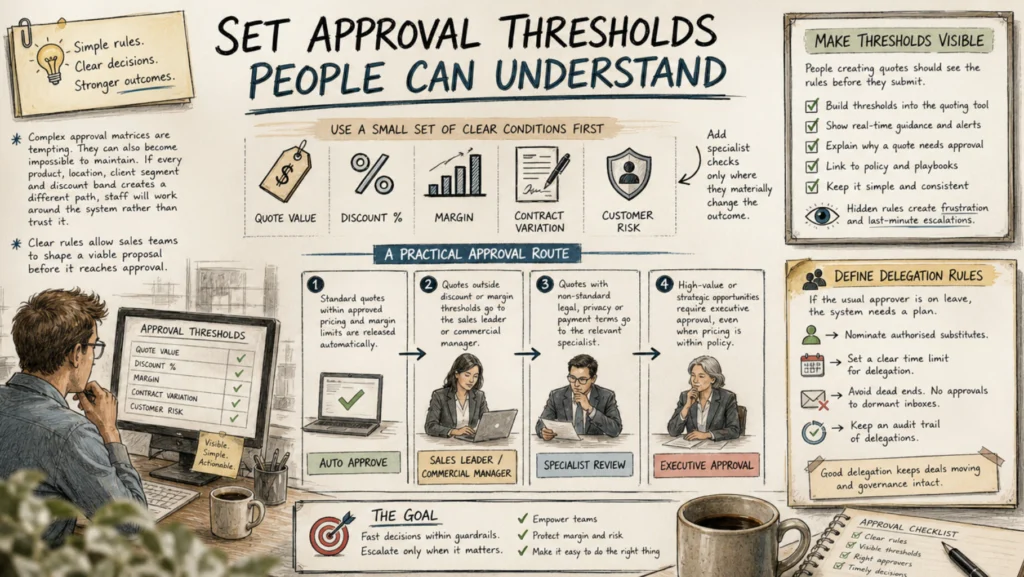
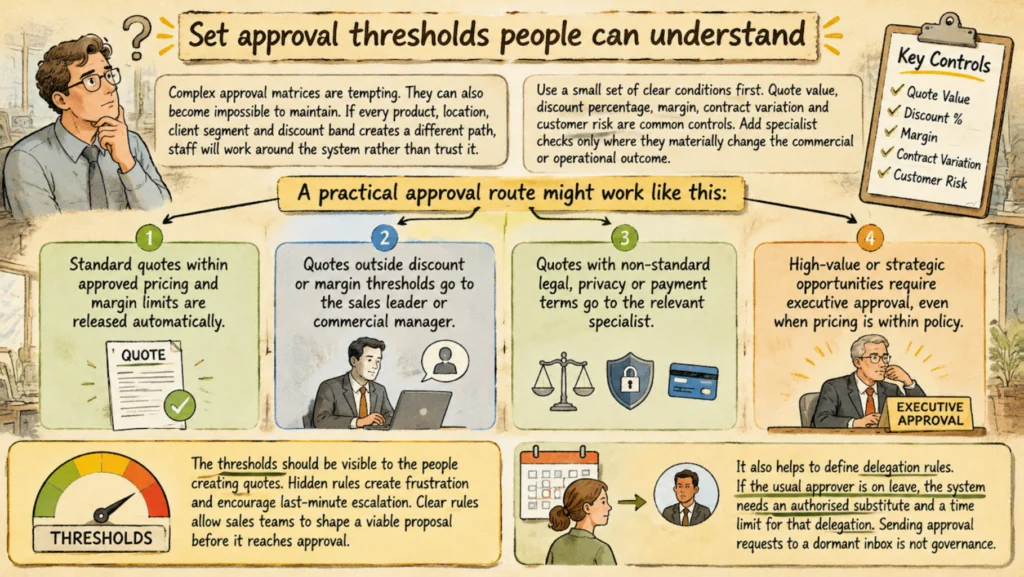
Complex approval matrices are tempting. They can also become impossible to maintain. If every product, location, client segment and discount band creates a different path, staff will work around the system rather than trust it.
Use a small set of clear conditions first. Quote value, discount percentage, margin, contract variation and customer risk are common controls. Add specialist checks only where they materially change the commercial or operational outcome.
A practical approval route might work like this:
- Standard quotes within approved pricing and margin limits are released automatically.
- Quotes outside discount or margin thresholds go to the sales leader or commercial manager.
- Quotes with non-standard legal, privacy or payment terms go to the relevant specialist.
- High-value or strategic opportunities require executive approval, even when pricing is within policy.
The thresholds should be visible to the people creating quotes. Hidden rules create frustration and encourage last-minute escalation. Clear rules allow sales teams to shape a viable proposal before it reaches approval.
It also helps to define delegation rules. If the usual approver is on leave, the system needs an authorised substitute and a time limit for that delegation. Sending approval requests to a dormant inbox is not governance.
Use AI for context, not unchecked authority
AI can improve quote approvals, particularly where the decision requires reading and comparing information across systems. It can summarise a statement of work, identify clauses that differ from the approved template, compare proposed pricing against similar accepted quotes, or prepare an approval brief for a manager.
That assistance should be bounded. An AI agent can gather evidence and recommend a route, but it should not silently approve a non-standard commercial commitment merely because it appears similar to a past deal. Similarity is not authority.
A controlled design gives the agent access only to the information required for its task. It applies policy checks, labels uncertainty and presents the supporting evidence to the authorised decision-maker. For higher-risk decisions, the human approval remains an explicit action rather than an assumed outcome.
This approach is particularly useful when quote information is spread across documents and internal applications. An orchestration layer can retrieve the right context, check permissions, coordinate the required systems and retain a record of what the agent used to reach its recommendation.
Design for exceptions and response times
The best automated route does not assume every quote is clean. It expects exceptions and makes them manageable.
Each approval request should give the approver enough information to decide without opening five systems: the quote value, discount, expected margin, relevant customer history, any policy exception and the proposed next action. Where a quote is blocked, the owner should see exactly what needs to change or who is responsible for the next decision.
Set service targets by risk. A routine discount exception may need an answer within four business hours. A high-value proposal with contract changes may reasonably take longer, but the requester should still see its status and current owner. Escalations should occur because a target was missed, not because a salesperson has sent three follow-up messages.
Avoid automating reminders without fixing accountability. Repeated alerts to a broad group can create noise while nobody owns the decision. Route each approval to a named role or individual, with escalation to a clearly defined fallback.
Ready to get started?
A one-line nudge that earns the click below.
Keep evidence at every decision boundary
A defensible approval process records more than an approved or rejected status. It should capture the quote version reviewed, the policy conditions applied, the relevant source data, the approver identity, their decision, any comments and the time of action.
This evidence matters when a customer later asks why a price was offered, when finance investigates a margin issue, or when leaders want to understand where revenue is being delayed. It also gives teams the information needed to improve the workflow rather than rely on anecdote.
Review the data monthly in the early stages. Look for quotes that repeatedly fail the same check, approvers who become bottlenecks, exceptions that should become a standard policy, and rules that are generating unnecessary escalation. Automation should make the operating model more visible, not harder to inspect.
Start with one quote type
Trying to automate every quote category at once usually creates a long design cycle and a fragile first release. Choose a high-volume, relatively standard quote type where delays are measurable and the approval logic is known. Establish a baseline for turnaround time, rework, approval rate and margin variance before changing the route.
Once the process is operating reliably, extend it to more complex quote types. This staged approach gives teams time to test policy thresholds, improve source data and build confidence in the controls. It also reveals where a human review is genuinely valuable and where it has become a habit with no decision purpose.
Quote approval automation works when speed and control are designed together. Build a route that captures the request, gathers the right context, checks policy, assigns authority and records the outcome. Then let your people spend their judgement where it changes the deal, rather than where it merely moves it along.