

An AI agent that can read an inbox, update a CRM, prepare a quote and schedule a technician is not simply a faster workflow. It is a participant in an operating system. Agent governance defines what that participant may do, what it must check, when it must stop, and how the business can prove why an action occurred.
That distinction matters when AI moves beyond drafting content and starts coordinating work across customer records, service systems, finance platforms and internal documents. The value can be substantial: fewer manual hand-offs, quicker response times and more capacity in teams already carrying too much administrative load. But without clear boundaries, speed can turn a small error into a chain of incorrect actions.
For Australian businesses, the practical question is not whether an agent is intelligent enough to act. It is whether the organisation has designed an accountable route for that action.
What agent governance actually controls
Agent governance is the operating framework around AI agents and automated decisions. It combines identity, permissions, policy rules, human authority and evidence. Its purpose is to make an agent useful within defined limits, rather than broadly autonomous in places where judgement, risk or accountability sit with people.
A conventional automation often follows a fixed trigger: when a form is submitted, create a task. An agent can interpret a request, retrieve context, choose between approved tools and propose or take an action. That flexibility is why agent systems require more deliberate governance. The same flexibility that helps an agent handle an unusual customer enquiry can also create uncertainty if the available data is incomplete or a policy conflict arises.
Good governance answers direct operational questions. Which identity is acting? What systems can it access? Which records can it view or change? What conditions must be met before it proceeds? Who approves a consequential exception? Where is the evidence trail?
These questions should be settled in the workflow design, not after an incident.
The five decision boundaries that matter
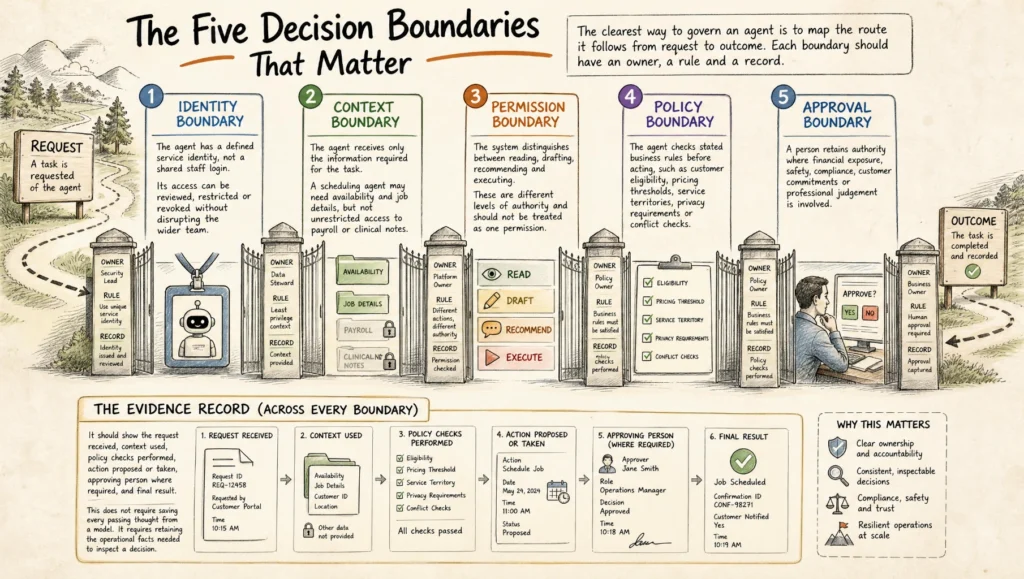
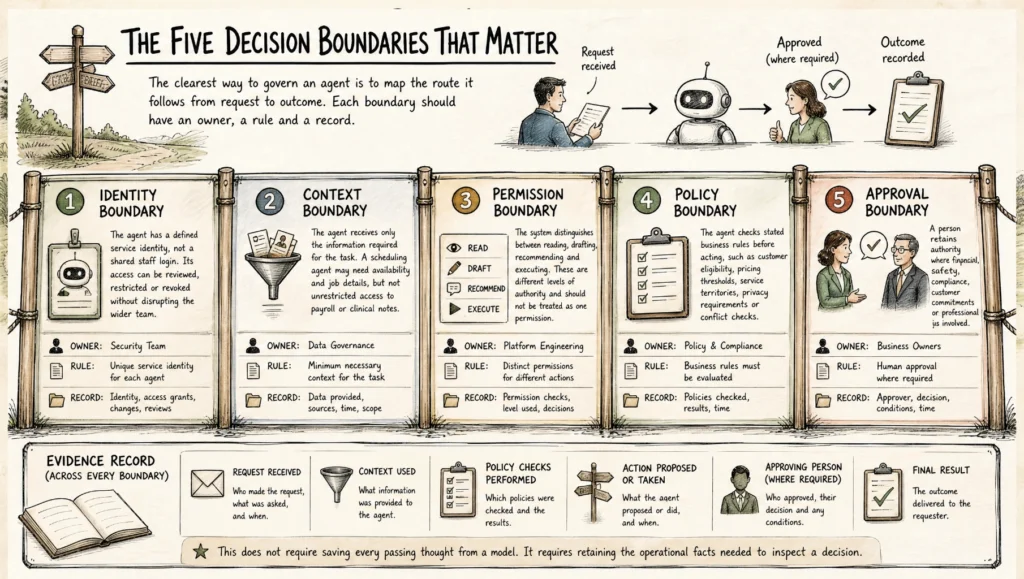
The clearest way to govern an agent is to map the route it follows from request to outcome. Each boundary should have an owner, a rule and a record.
- Identity boundary: The agent has a defined service identity, not a shared staff login. Its access can be reviewed, restricted or revoked without disrupting the wider team.
- Context boundary: The agent receives only the information required for the task. A scheduling agent may need availability and job details, but not unrestricted access to payroll or clinical notes.
- Permission boundary: The system distinguishes between reading, drafting, recommending and executing. These are different levels of authority and should not be treated as one permission.
- Policy boundary: The agent checks stated business rules before acting, such as customer eligibility, pricing thresholds, service territories, privacy requirements or conflict checks.
- Approval boundary: A person retains authority where financial exposure, safety, compliance, customer commitments or professional judgement is involved.
The evidence record sits across every boundary. It should show the request received, context used, policy checks performed, action proposed or taken, approving person where required, and final result. This does not require saving every passing thought from a model. It requires retaining the operational facts needed to inspect a decision.
Not every action needs a human approval
A common response to AI risk is to put approval gates everywhere. That can make an implementation feel safe while creating a slower and more frustrating process than the manual one it replaced. Governance should be proportionate to the consequence of the action.
An agent can usually proceed automatically when the action is reversible, low value, policy-bound and well evidenced. For example, it may classify an inbound enquiry, create a service request, acknowledge receipt, retrieve relevant documents or assign a standard task based on agreed rules.
The approval threshold should rise when an action changes money, commitments or sensitive information. Issuing a non-standard quote, approving a refund, changing a clinical administration record, closing a legal matter, or sharing confidential material externally should generally require a clearly identified human decision-maker.
There is also a middle ground. An agent can prepare the work, explain the basis for its recommendation and place it in an approval queue. This is often the most valuable initial pattern for professional services and healthcare administration: people spend less time assembling information, while retaining ownership of the decision.
Design governance around real work, not a policy document
A policy that says AI must be used responsibly is not a workflow control. Teams need to see how governance operates at the point where work changes hands.
Consider a field service business handling an urgent maintenance request. The route may begin when a customer email arrives. The agent captures the issue, identifies the asset and service agreement, checks whether the caller is authorised, assesses the service level, and finds suitable technician availability. If the job fits standard scope and pricing, it can create a proposed booking and notify the dispatcher. If the request involves a safety issue, an out-of-contract rate or a site access exception, it stops and requests approval with the relevant facts attached.
The benefit is not that the agent replaces a dispatcher. It removes repetitive coordination while making exceptions more visible. The dispatcher can focus on capacity, customer communication and decisions that require experience.
This approach also works across fragmented software environments. A governed agent may connect a CRM, inbox, ERP, document repository and service desk through controlled integrations or Model Context Protocol servers. The technical connection matters, but the operating design matters more. Each connection needs a stated purpose, bounded access and a way to inspect the actions performed through it.
Assign ownership before scaling agents
When an agent makes a poor recommendation or an incorrect update, responsibility cannot sit vaguely with “the AI”. A functioning governance model assigns ownership across the operating route.
The business owner defines the desired outcome and acceptable risk. The process owner sets the policy rules and exception paths. Technology leaders oversee identities, access, integrations and monitoring. Frontline teams provide the reality check: whether the route handles the conditions that occur in actual work. A designated approver owns consequential decisions that the agent escalates.
These roles do not need to create a large committee. In a growing organisation, one operations leader may hold several responsibilities. What matters is that someone can answer a question, alter a rule and approve a material change without uncertainty.
SpeedOz approaches this as system design, not chatbot deployment. The objective is to connect useful tools and data while keeping human authority explicit at the points where it belongs.
Ready to get started?
A one-line nudge that earns the click below.
Measure control and capacity together
Governance is often discussed as a risk cost. In practice, it can improve performance because clear routes reduce rework, ambiguity and hidden manual effort. The measures should reflect both sides.
Track the time from request to completed outcome, the percentage of work handled without manual data entry, the rate of approved recommendations, and the volume and reason for escalations. Then track errors, reversals, policy exceptions, access failures and any actions taken outside intended authority.
High escalation rates are not automatically a failure. Early in deployment, they can reveal poorly defined rules or legitimate variation in the work. The useful question is whether the escalations are producing better policy design. If a team repeatedly approves the same exception, the process may need a new rule. If exceptions remain unpredictable and high consequence, that is a signal to preserve human review.
Start with one accountable route
The strongest first use case is usually not the most impressive demonstration. It is a frequent operational route with clear inputs, existing business rules, measurable delay and a manageable downside if the agent proposes rather than executes.
Map the route from request through context, policy, approval, action and evidence. Decide which actions are automatic, which are proposed, and which are prohibited. Test edge cases with the people who handle the work daily. Then review real evidence after launch and refine the boundaries.
Well-governed agents do not make a business less human. They make human judgement more available for the decisions that deserve it.