

An AI agent that can read a customer email, access a CRM and trigger work in an ERP is no longer a simple productivity tool. It is part of your operating model. Knowing how to govern AI agents means deciding what they may do, what they must escalate, and how every consequential action can be examined after the fact.
For Australian businesses with fragmented systems and pressure on operational teams, the objective is not to put controls around every minor task. It is to create clear routes for work. An agent should move routine work quickly, stop at meaningful boundaries, obtain approval where judgement is required, and leave evidence behind.
Governance starts with the route, not the model
Many AI projects begin by choosing a model or testing a chat interface. That can be useful for experimentation, but it is the wrong starting point for operational deployment. Governance begins with the work itself: the request, the available context, the decision points, the systems involved and the outcome that must be recorded.
Take a field service business. A customer sends an email reporting an equipment fault. An agent may classify the request, identify the site and asset, check service eligibility, prepare a job brief and propose an appointment. Those are separate actions with different levels of risk. Classifying an email is low consequence. Changing a service commitment, assigning a technician or issuing a credit is not.
Map that route before building the agent. Identify where it can act independently and where authority remains with a person. This turns governance from a policy document into a practical part of workflow design.
Separate assistance from authority
An agent can be useful without being authorised to make final decisions. This distinction is central.
In healthcare administration, an agent may summarise a referral, identify missing fields and draft correspondence. It should not independently determine clinical priority. In professional services, it may assemble a matter brief and prepare a response based on approved material. It should not give advice, accept contractual terms or send a final opinion without professional review.
The question is not whether the agent is capable of an action. The question is whether the business is prepared to delegate that authority. Capability and authority are different controls.
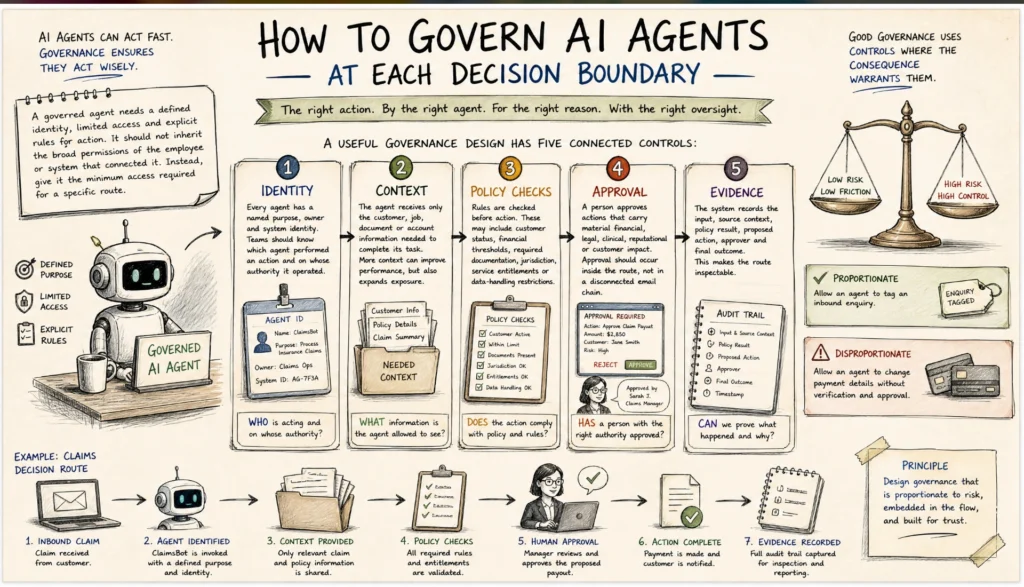
How to govern AI agents at each decision boundary
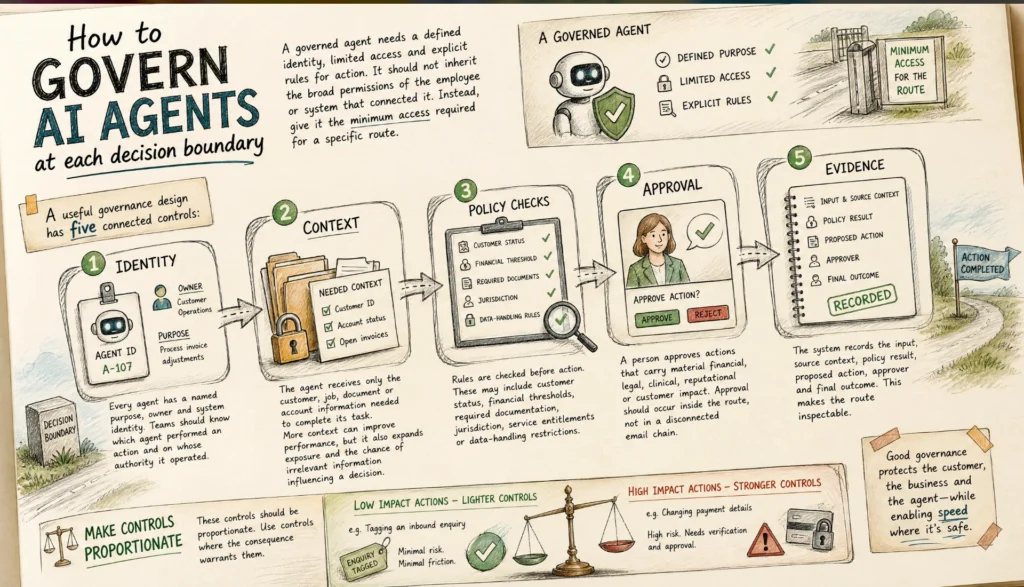
A governed agent needs a defined identity, limited access and explicit rules for action. It should not inherit the broad permissions of the employee or system that connected it. Instead, give it the minimum access required for a specific route.
A useful governance design has five connected controls:
- Identity: Every agent has a named purpose, owner and system identity. Teams should know which agent performed an action and on whose authority it operated.
- Context: The agent receives only the customer, job, document or account information needed to complete its task. More context can improve performance, but it also expands exposure and the chance of irrelevant information influencing a decision.
- Policy checks: Rules are checked before action. These may include customer status, financial thresholds, required documentation, jurisdiction, service entitlements or data-handling restrictions.
- Approval: A person approves actions that carry material financial, legal, clinical, reputational or customer impact. Approval should occur inside the route, not in a disconnected email chain.
- Evidence: The system records the input, source context, policy result, proposed action, approver and final outcome. This makes the route inspectable.
These controls should be proportionate. Requiring approval for an agent to tag an inbound enquiry will create friction with little benefit. Allowing an agent to change payment details without a verification and approval route creates an avoidable risk. Good governance uses controls where the consequence warrants them.
Define permission levels that match operational risk
Not every agent needs the same operating model. A practical approach is to classify actions by permission level.
At the first level, an agent can retrieve, organise and draft. It can search approved knowledge sources, extract document fields, categorise work and prepare a response for review. This is often the right place to begin because it creates capacity while retaining close human control.
At the next level, it can act within preset rules. It may create a service ticket, request missing information, update a record or schedule a follow-up if required conditions are met. The conditions must be explicit and testable, not implied by a loose instruction.
The highest level is consequential action. This includes approving refunds, changing contract terms, lodging regulated information, reallocating resources, making recommendations that affect care or employment, and sending communications that make a commitment on behalf of the business. These actions generally require human approval, dual checks or a tightly constrained exception process.
Thresholds will differ by business. A small professional firm may require approval for every client-facing advice draft. A high-volume service operation may permit automatic appointment confirmations but require approval for any reschedule that breaches service-level commitments. The right setting depends on risk, volume, customer expectation and the quality of the source data.
Make policy executable, not aspirational
Policies written only for people are hard for agents to apply consistently. “Use good judgement” and “prioritise important customers” may guide an experienced employee, but they are not executable instructions.
Translate policy into conditions. For example: an agent may issue a standard acknowledgement if the request contains no complaint indicator, no safety term and no overdue account flag. It must route the item to a team member if it identifies a complaint, suspected safety incident, legal request, payment dispute or confidence below the agreed threshold.
This does not remove judgement from the business. It places judgement where it belongs: in setting the policy, reviewing exceptions and deciding when rules should change. The agent applies the route consistently; people retain ownership of consequential decisions.
Where systems are connected through APIs, workflow tools or Model Context Protocol (MCP) servers, apply these checks before a tool is called. An agent should not be able to reach an ERP, document repository or service desk merely because it was asked in natural language. The orchestration layer should validate identity, permissions, data scope and approval state first.
Build evidence into the workflow
If an agent cannot explain the basis for an action, your team cannot properly supervise it. Evidence is not a reporting exercise added after implementation. It is a workflow requirement.
For each material action, capture the source records used, relevant policy checks, the agent’s proposed action, any human amendment, approval details and the final system update. In many cases, storing full prompts is neither necessary nor desirable. What matters is preserving the operational evidence needed to understand what occurred and to resolve a customer, compliance or internal review question.
This is especially valuable when work crosses departments. A sales enquiry can become a service request, a billing question or a delivery issue. Clear evidence stops teams from reconstructing the story through inboxes, spreadsheets and verbal handovers.
Monitor the exceptions, not just the activity
Governance is not complete at go-live. Agent performance changes as workflows, policies, data sources and customer behaviour change. A route that worked well with a limited document set may become unreliable after a new product line or business system is introduced.
Monitor outcomes at the decision boundary. Look for approval rejection rates, policy exceptions, failed integrations, repeated escalations, customer corrections and actions that staff reverse. These indicators reveal whether the agent lacks context, has unclear rules, is receiving poor source data or has been given too much authority.
Regular review should include the operational owner, the relevant department lead and the technical team. The purpose is not to judge every imperfect response. It is to improve the route: tighten permissions, add a policy check, improve the source knowledge or remove an approval step that no longer adds value.
Ready to get started?
A one-line nudge that earns the click below.
Treat ownership as an operating responsibility
Every production agent needs a business owner. Technology teams can maintain integrations, access controls and monitoring, but they should not silently become accountable for commercial, clinical or professional judgement. The business owner defines acceptable outcomes, approves policy changes and accepts the residual risk of delegated actions.
This is where many deployments stall. Teams buy an AI tool, connect a few systems and assume governance will emerge through usage. It will not. Without ownership, exceptions accumulate, permissions widen and staff lose confidence in the system.
SpeedOz approaches AI automation as an accountable operating route: capture the request, connect the right context, check policy, obtain approval where required, coordinate the work and record the outcome. That structure gives organisations room to automate without turning critical decisions into a black box.
The strongest governed agents are not the ones that appear most autonomous. They are the ones your people can trust to move ordinary work forward, pause at the right boundary and show exactly how they arrived there.