

A service team should not need to copy a customer request from an inbox into a CRM, check a job history in another system, draft a response, seek approval, and update three more records. Yet this is how work still moves through many growing businesses. AI implementation services exist to change that operating reality – not by adding another chatbot, but by designing accountable routes between the systems, people and decisions that already run the business.
The distinction matters. A convincing AI demonstration can answer questions from a document set. An operational AI system must know whose request it is handling, what information it may access, which policy applies, when a person must approve an action, and what evidence should be recorded afterwards. That is the difference between experimentation and implementation.
AI implementation services are operational design
AI implementation is often described as deploying a model. In practice, the model is only one component. The work is closer to operational systems design: mapping how a request enters the business, establishing the context required to act on it, connecting the relevant applications, setting decision boundaries, and making the resulting workflow observable.
For an Australian field service business, that might mean an agent receives an after-hours maintenance enquiry, identifies the site and service agreement, checks technician availability, classifies urgency against agreed rules, and prepares a dispatch recommendation. It does not independently authorise a costly call-out or alter contractual terms. A designated manager retains that authority, with the relevant job history and reasoning presented for approval.
The same pattern applies in healthcare administration and professional services. AI can prepare a referral pack, reconcile information across a case file, or draft a client update. Where privacy, clinical judgement, legal advice or financial authority are involved, the system should route the work to the accountable person rather than blur the boundary.
Good implementation services therefore begin with a plain question: where does work slow down, repeat itself, or disappear between teams? The answer is rarely a single task. It is usually a chain of hand-offs, fragmented context and unclear ownership.
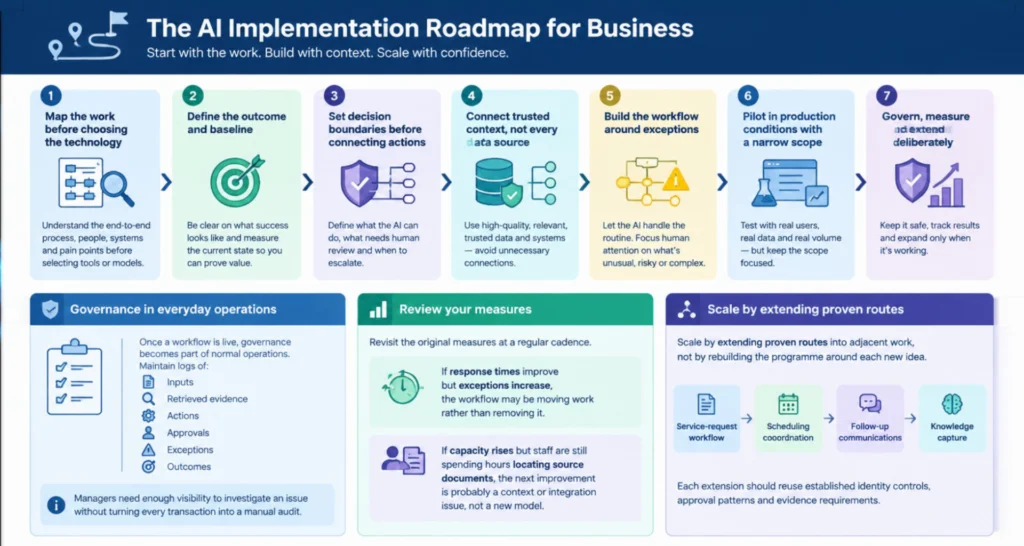
Start with the route, not the technology
The most valuable use cases are specific enough to measure. “Use AI for customer service” is too broad to design or govern. “Reduce the time required to triage and prepare complete responses to warranty claims” gives an implementation team something real to examine.
A useful discovery process follows the work from start to finish. It captures the triggering event, the people involved, the systems touched, the information required, the decisions made, the exceptions that occur and the final business record. This often exposes issues that have been accepted as normal: staff re-keying data, approvals buried in email, inconsistent document versions, or revenue opportunities waiting days for a response.
The next step is to separate work into three categories. Some work can be automated under clear rules, such as assigning a request to the right queue. Some can be AI-assisted, such as summarising a long service history or extracting details from a supplier document. Some remains human-led because its consequence, ambiguity or authority warrants professional judgement.
This is not a limitation of AI. It is sound operating design. Automation should reduce administrative drag while preserving ownership of consequential decisions.
Define the evidence required to act
Every meaningful action should have a basis. If an agent recommends a technician, it should be able to show the availability data, service region, relevant skills and priority rule it used. If it drafts a proposal, the source material and pricing assumptions should be identifiable.
Inspectable evidence makes a system easier to trust, improve and govern. It also gives teams a practical way to handle disputes and exceptions. Rather than asking why an AI tool produced a response, an operations leader can inspect the route: what request arrived, what context was retrieved, which policy check passed or failed, who approved the next step, and what was written back to the system of record.
What a capable implementation looks like
The delivery process should be deliberate, but it should not become a prolonged architecture exercise detached from business value. A practical programme usually starts with one high-friction workflow that has sufficient volume, accessible data and a clear owner. It then expands from a proven route.
First, the implementation team connects the relevant business systems. These may include a CRM, ERP, service desk, inbox, document repository, job management platform and internal application. The aim is not to centralise every record in a new AI database. It is to make authorised context available at the point it is needed while keeping source systems authoritative.
Next comes orchestration. A request may need several specialised agents or services working in sequence: one identifies the customer and retrieves the case, another extracts information from attachments, another checks policy, and another creates a draft task. Model Context Protocol, or MCP, can provide a controlled way for AI agents to use approved tools and business data. The technical detail matters less than the operating principle: access is purposeful, limited and traceable.
Then the team designs controls at decision boundaries. A low-risk action, such as creating a draft record, may proceed automatically. A customer-facing message may require a staff member to review it. A payment change, contract variation or clinical administration step may demand a named approver and additional verification. Permissions should reflect the actual authority structure of the business, not the convenience of the workflow.
Finally, the route is tested against ordinary work and awkward reality. What happens if the customer record is duplicated? What if an attachment is unreadable, a policy is unclear, or a request arrives outside operating hours? Exceptions are not evidence that a system has failed. They are where governance proves its value.
LET’S BUILD WHAT’S NEXT
Make your next move
an intelligent one.
Tell us where the bottlenecks are. Let’s explore what AI can do for your business.
Measure capacity, quality and control together
A fast workflow is not automatically a better workflow. If an automated process creates poor customer communications, duplicates records or pushes risky decisions through without review, its apparent efficiency is expensive.
The stronger measures combine capacity with quality. Look at response time, case handling time, backlog age, rework, completion rates and the proportion of work requiring escalation. Pair these with control measures: approval compliance, exceptions caught, source citation coverage, unauthorised action attempts blocked, and the accuracy of updates written to core systems.
The baseline matters. If a team currently spends six hours each day preparing job packs, a system that safely removes half that effort creates real capacity. That capacity might support more jobs, faster client communication, better follow-up or less overtime. The appropriate outcome depends on the operating pressure the business is trying to relieve.
Avoid claiming savings before the route is stable. Early results can be distorted by small volumes, staff learning the new process, or poor source data. A disciplined implementation uses a defined review period, compares performance with the baseline, and adjusts prompts, rules, integrations and approvals based on evidence.
Common reasons AI programmes stall
Many AI programmes stall because the initial scope is too broad. Teams attempt to connect every application, solve every process problem and support every exception before proving a single workflow. The result is often a lengthy project with no visible operational gain.
Others fail in the opposite direction. A standalone tool is introduced without access to the systems where work actually happens. Staff must manually copy its output into their normal applications, so the promised time saving disappears and accountability becomes harder to follow.
Governance can also be treated as a late-stage compliance task. That creates rework. Identity, access rights, retention rules, approval paths and audit records should shape the design from the first workflow map. They are not obstacles placed around innovation. They are what make responsible automation usable in a real business.
There is also no single answer to how much autonomy an AI system should have. A high-volume internal knowledge request may be safely handled with minimal review. A recommendation affecting a patient, employee, customer contract or material expenditure deserves a tighter boundary. The right level of automation depends on consequence, confidence, data quality and the availability of a capable human owner.
Choose a partner that can carry the work into operations
When assessing AI implementation services, ask for more than a demonstration. Ask how the provider maps workflows, integrates with existing systems, controls access, handles exceptions, records evidence and measures outcomes after go-live. Ask who owns the process when a result is wrong or incomplete.
SpeedOz approaches implementation as an accountable operating route. The objective is connected action across the tools your teams already use, with clear boundaries around who can decide, approve and act. That may involve intelligent agents, workflow automation, bespoke development or a combination of all three. The technology should follow the operational requirement.
The most useful first move is modest and concrete: choose one workflow where delays, repeated handling or missing context are costing the team time. Define the decision boundary before building the automation. When the route is clear, AI has a practical place to do its best work – preparing, coordinating and accelerating action while people remain responsible for what matters.