

Introduction
Automating complex business operations with AI agents is transforming how organizations streamline workflows, reduce operational costs, and enhance decision-making. AI agents are specialized software entities that can perform tasks autonomously or collaboratively, orchestrating intricate processes that involve multiple stakeholders and systems. This guide explains how businesses can leverage AI agents to automate complex operations efficiently, offering practical insights for practitioners and decision-makers evaluating automation strategies.
Key Concepts
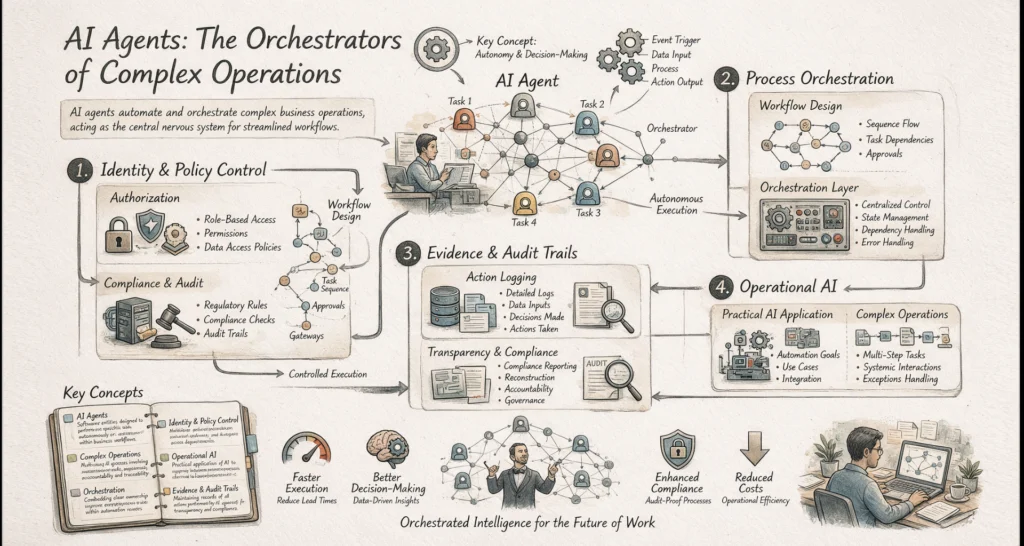
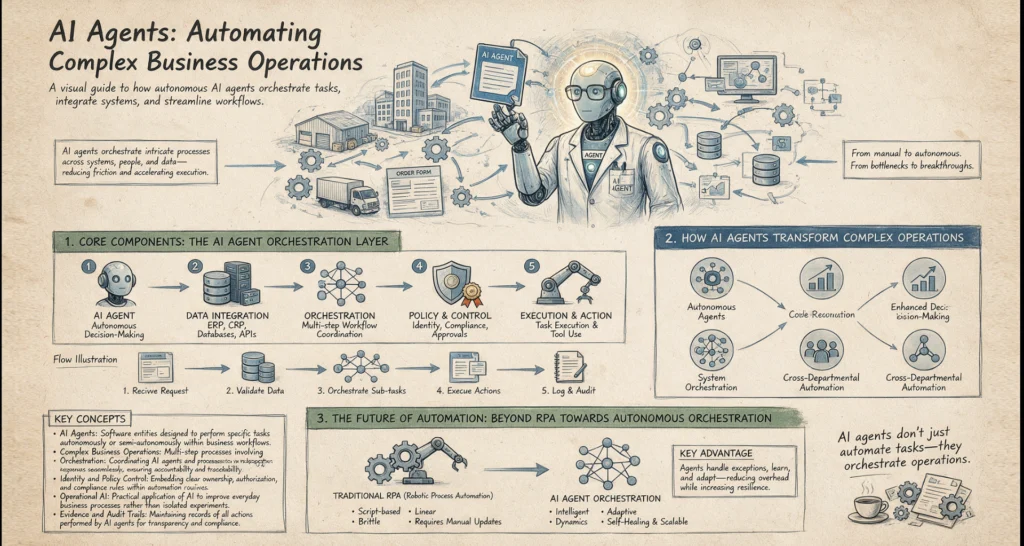
- AI Agents: Software entities designed to perform specific tasks autonomously or semi-autonomously within business workflows.
- Complex Business Operations: Multi-step processes involving numerous tasks, approvals, and data exchanges across departments.
- Orchestration: Coordinating AI agents and processes to work together seamlessly, ensuring accountability and traceability.
- Identity and Policy Control: Embedding clear ownership, authorization, and compliance rules within automation routes.
- Operational AI: Practical application of AI to improve everyday business processes rather than isolated experiments.
- Evidence and Audit Trails: Maintaining records of all actions performed by AI agents for transparency and compliance.
Detailed Analysis with Practical Examples
Understanding the Scope of Automation
Complex business operations often include workflows like order processing, compliance checks, customer onboarding, supply chain management, and financial reconciliation. Automating these requires AI agents capable of interpreting data, making decisions based on policies, and collaborating across systems.
How to design AI Agent Orchestration
Effective automation starts with designing a clear orchestration framework. This involves:
- Defining the roles and responsibilities of each AI agent.
- Incorporating identity verification to ensure accountability.
- Embedding policy rules that govern agent decisions.
- Setting approval gates where human intervention is necessary.
For example, in a financial approval workflow, an AI agent might validate invoice details and flag discrepancies, while a human manager provides final approval. The orchestration system records each step, creating an audit trail.
How Can You Leverage AI for Better Decision-Making?
Yes, AI agents can analyze large datasets and apply machine learning models to make informed decisions. For instance, in supply chain operations, AI agents can predict inventory shortages and automatically trigger procurement processes, reducing downtime and manual oversight.
Can AI Agents integrate with Existing Systems?
Fact is AI agents must integrate with ERP, CRM, and other enterprise systems to access real-time data and execute tasks. Using APIs and middleware, AI agents can communicate seamlessly, reducing data silos and improving operational flow.
How to ensure AI Agents for Accountability and Compliance
Best practise: Embedding identity, policy, and evidence within AI agent routes ensures every action is inspectable. This is critical for industries with regulatory requirements, such as finance, healthcare, and manufacturing.
Example Scenario: Automating Customer Onboarding
A bank uses AI agents to automate onboarding by verifying documents, running compliance checks, and setting up accounts. The orchestration system assigns tasks to specialized AI agents, escalates exceptions to human staff, and logs all decisions. This reduces onboarding time from days to hours, improves accuracy, and maintains regulatory compliance.
Conclusion
Automating complex business operations with AI agents is no longer a futuristic concept but an actionable strategy that drives efficiency, accountability, and scalability. By designing robust orchestration frameworks that integrate AI decision-making, enforce policies, and maintain clear audit trails, businesses can unlock significant value.
Ready to transform your operations? Explore AI agent orchestration solutions to start automating complex workflows with confidence and clarity.
LET’S BUILD WHAT’S NEXT
Make your next move
an intelligent one.
Tell us where the bottlenecks are. Let’s explore what AI can do for your business.
Questions and Answers(Q&A)
What are AI agents in business operations?
AI agents are autonomous or semi-autonomous software programs that perform specific tasks within business workflows, such as data analysis, decision-making, and process execution.
How do AI agents handle complex operations?
They operate through orchestration frameworks that coordinate multiple agents, enforce policies, manage approvals, and maintain evidence of actions, enabling them to manage multi-step, interdependent tasks.
What are the benefits of automating with AI agents?
Benefits include improved operational efficiency, reduced costs, enhanced accuracy, faster decision-making, and better compliance through transparent audit trails.
How do I ensure accountability when using AI agents?
By integrating identity management, policy enforcement, approval mechanisms, and detailed logging within the automation architecture, every action performed by AI agents can be traced and audited.
Can AI agents work with existing enterprise systems?
Yes, AI agents can integrate with ERP, CRM, and other software using APIs and middleware to access data and execute tasks seamlessly.
What industries benefit most from AI agent automation?
Industries with complex, regulated operations such as finance, healthcare, manufacturing, and supply chain management see significant gains.
How do I start automating complex operations with AI agents?
Begin by identifying high-impact workflows, designing an orchestration framework with clear roles and policies, integrating AI agents with your systems, and establishing audit and approval processes.