

A service team receives a customer request in a shared inbox. An AI tool drafts a reply, another extracts details from an attachment, and a workflow creates a job in the field system. It looks efficient until the wrong site is selected, a quote is issued without authority, or the customer record is updated with incomplete information. This is where many AI project failures begin: not with a dramatic model error, but with an ordinary operational hand-off that nobody designed, owned or checked.
The issue is rarely that an organisation chose the wrong model. More often, it tried to place AI on top of an unclear process. A pilot can produce impressive demonstrations while avoiding the difficult work: defining the source of truth, setting permissions, deciding when a person must approve an action, and recording what happened.
For Australian businesses with fragmented systems and lean teams, that distinction matters. AI can create real capacity, but only when it has a defined route through the business.
AI project failures are usually operating failures
Most AI initiatives start with a sensible ambition: reduce administration, shorten response times, improve consistency or surface useful information from documents. The project then becomes centred on the tool. Teams compare chat interfaces, build a proof of concept, or ask a model to automate a task before they have mapped the work around it.
That approach creates a gap between a convincing demo and a dependable operating system. A demo usually assumes clean inputs, one user, no exceptions and no consequences. Daily work does not. It arrives through inboxes, phone notes, PDFs, CRM records and conversations. It includes missing details, conflicting instructions, urgent requests and decisions that require professional judgement.
A better starting point is the workflow itself. Capture the request. Connect the relevant context. Check policy and authority. Obtain approval where needed. Coordinate work across systems. Record the outcome and evidence. AI may assist at several points in that route, but it should not obscure who owns the decision.
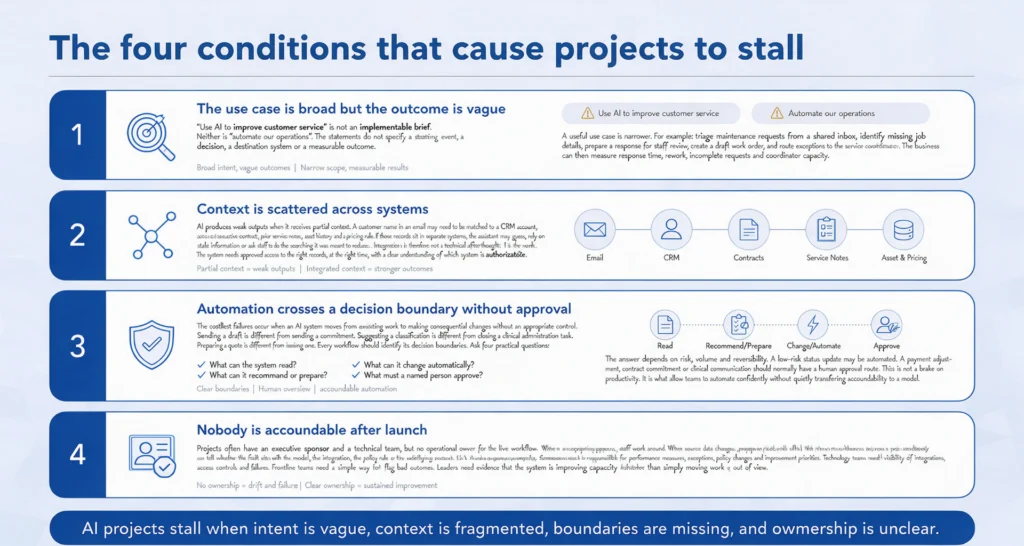
The four conditions that cause projects to stall
1. The use case is broad but the outcome is vague
“Use AI to improve customer service” is not an implementable brief. Neither is “automate our operations”. These statements do not specify a starting event, a decision, a destination system or a measurable outcome.
A useful use case is narrower. For example: triage maintenance requests from a shared inbox, identify missing job details, prepare a response for staff review, create a draft work order, and route exceptions to the service coordinator. The business can then measure response time, rework, incomplete requests and coordinator capacity.
Narrow does not mean low value. It means the organisation can prove value under real conditions before extending the route. The best first workflows are often repetitive, cross-functional and frustrating, with clear human ownership at the exceptions.
2. Context is scattered across systems
AI produces weak outputs when it receives partial context. A customer name in an email may need to be matched to a CRM account, an active contract, prior service notes, asset history and a pricing rule. If those records sit in separate systems, the assistant may guess, rely on stale information or ask staff to do the searching it was meant to reduce.
Integration is therefore not a technical afterthought. It is the work. The system needs approved access to the right records, at the right time, with a clear understanding of which system is authoritative.
This does not require copying every business record into an AI platform. In many cases, a more controlled approach is better: retrieve only the relevant information for the task, apply identity and permission checks, then write back only after the required approval. MCP server integrations and well-designed orchestration can support this pattern, but the technology is secondary to the rule: context must be relevant, governed and traceable.
LET’S BUILD WHAT’S NEXT
Make your next move
an intelligent one.
Tell us where the bottlenecks are. Let’s explore what AI can do for your business.
3. Automation crosses a decision boundary without approval
The costliest failures occur when an AI system moves from assisting work to making consequential changes without an appropriate control. Sending a draft is different from sending a commitment. Suggesting a classification is different from closing a clinical administration task. Preparing a quote is different from issuing one.
Every workflow should identify its decision boundaries. Ask four practical questions:
- What can the system read?
- What can it recommend or prepare?
- What can it change automatically?
- What must a named person approve?
The answer depends on risk, volume and reversibility. A low-risk status update may be automated. A payment adjustment, contract commitment or clinical communication should normally have a human approval route. This is not a brake on productivity. It is what allows teams to automate confidently without quietly transferring accountability to a model.
4. Nobody is accountable after launch
Projects often have an executive sponsor and a technical team, but no operational owner for the live workflow. When an exception appears, staff work around it. When source data changes, prompts and rules drift. When the process delivers a poor result, nobody can tell whether the fault sits with the model, the integration, the policy rule or the underlying process.
Live AI needs operating ownership. Someone must be responsible for performance measures, exceptions, policy changes and improvement priorities. Technology teams need visibility of integrations, access controls and failures. Frontline teams need a simple way to flag bad outcomes. Leaders need evidence that the system is improving capacity rather than simply moving work out of view.
Build the route before scaling the automation
A disciplined implementation does not begin by asking which AI tool to buy. It begins by observing how work actually moves. That means tracing a request from intake to completion, including the informal checks people perform because the written process never captured them.
For a professional services firm, the route might begin with an enquiry, match it to the right matter, retrieve relevant documents, identify missing information, prepare an engagement response, and seek partner approval before anything is sent. For a healthcare administration team, it may involve extracting referral details, checking completeness, assigning a queue and escalating uncertain cases to trained staff. For field service, it may mean converting an inbound request into a job only after asset, location, entitlement and technician availability are verified.
Each route should define inputs, system actions, exception paths and evidence. Evidence may include the records retrieved, the policy checks applied, the approval received and the final action taken. This makes the workflow inspectable. It also makes improvement possible, because teams can see where work slows down or where the AI needs better instructions, context or guardrails.
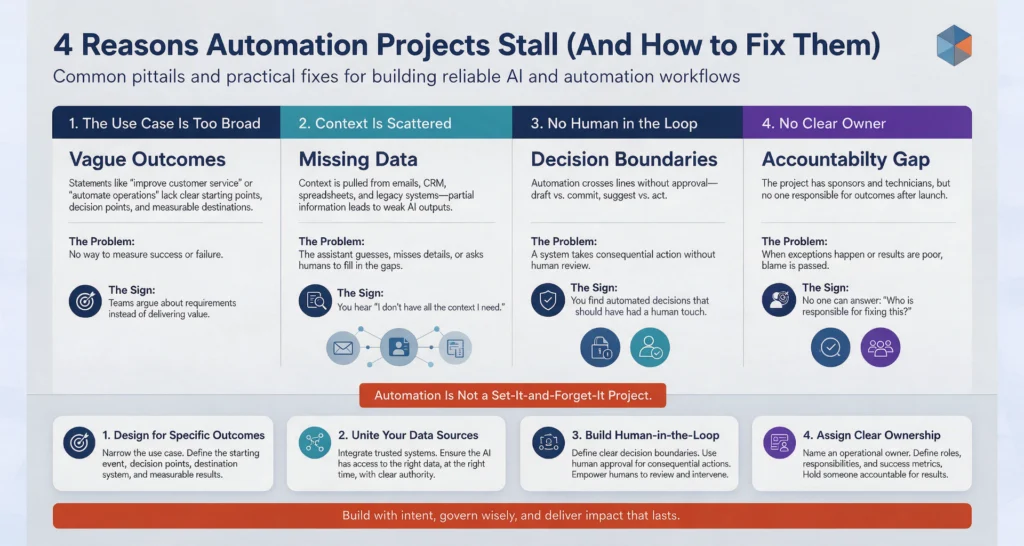
Measure capacity, not activity
A common reporting mistake is to count AI activity: prompts processed, documents summarised or tickets touched. These measures may be useful for monitoring, but they do not establish business value.
Measure what changed in the operation. Did time to first response fall? Are fewer jobs returned for missing information? Has the team reduced manual copying between systems? Are service coordinators handling more valid requests without an increase in errors? Has the approval queue become faster and more consistent?
There are trade-offs. A workflow designed for maximum speed may create more exceptions. A workflow with multiple approvals may be safer but provide little relief for staff. The right design depends on the consequence of error and the cost of delay. The objective is not full automation. It is the best controlled allocation of work between people, systems and AI.
Treat exceptions as the design signal
Teams sometimes view exceptions as proof that the automation is failing. In reality, exceptions often show where business judgement belongs. An ambiguous customer request, an incomplete referral or a conflict between two systems may be exactly the situation that should be routed to a person.
The problem is not that exceptions exist. It is when they arrive without context, ownership or a clear next action. A good route presents the relevant evidence, explains why the case was stopped, and lets the authorised person decide quickly. That decision can then improve rules, data quality or future AI instructions.
SpeedOz approaches AI automation as an accountable operating route, not a standalone chatbot. The distinction is practical: connected systems, clear boundaries, and evidence at the points where decisions matter.
The next useful question is not, “Where can we add AI?” Ask instead: “Which recurring piece of work would improve if the right context arrived, policy was checked, and a person retained authority where it counts?” Start there. Build one route that your team can inspect and trust. Then let the results determine what deserves to scale.