

A service coordinator asks an AI agent to reschedule a technician, notify the customer, update the CRM and issue a revised work order. That sounds efficient until the booking involves a restricted site, a contract exception or a technician without the required certification. The best AI policy controls make the difference between fast automation and an uncontrolled chain of actions.
For Australian businesses moving beyond isolated AI experiments, policy is not a document sitting in a shared drive. It is an operating mechanism. It decides what an agent can see, what it can recommend, what it can do without permission, when a person must approve the next step, and what evidence is retained afterwards.
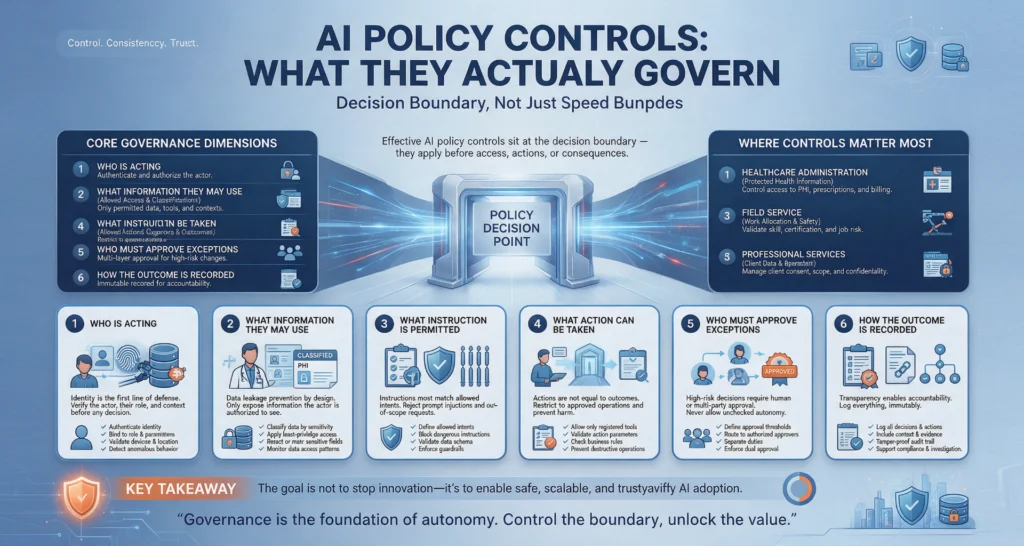
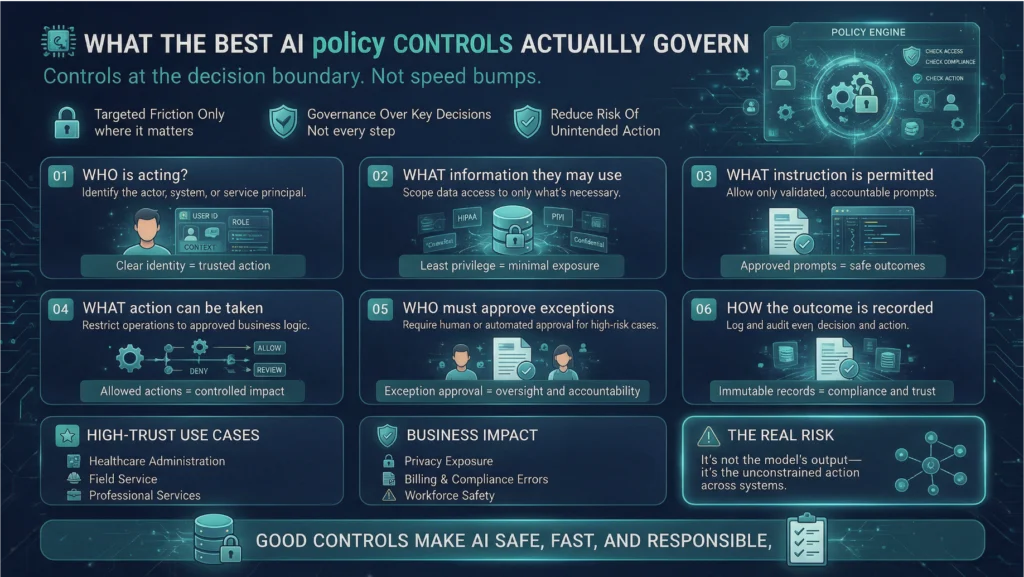
What the best AI policy controls actually govern
An effective AI policy control sits at a decision boundary. It applies before an agent accesses sensitive information, sends an external message, changes a record, allocates work or triggers a financial consequence. The purpose is not to slow every workflow down. It is to place friction only where the business needs authority, care or proof.
The best controls govern six practical questions: who is acting, what information they may use, what instruction is permitted, what action can be taken, who must approve exceptions, and how the outcome is recorded. If one of those questions has no clear answer, the workflow is not ready for autonomous action.
This is especially relevant in healthcare administration, field service and professional services. A missed approval may expose private client information, create a billing error or place the wrong person on a regulated job. The risk is rarely the model producing a poor sentence. It is the model being allowed to move work across systems without enough context or constraint.
LET’S BUILD WHAT’S NEXT
Make your next move
an intelligent one.
Tell us where the bottlenecks are. Let’s explore what AI can do for your business.
Start with the route, not the AI tool
Teams often begin by asking which model or agent platform has the strongest safety features. That matters, but it is not the starting point. A policy control that exists only inside one tool cannot govern the full route from request to outcome.
Map the operational flow first. Capture the trigger, the systems involved, the data sources, the decisions, the actions and the people accountable for exceptions. A typical route might look like this: a customer email arrives, an agent classifies the request, retrieves job history from the CRM, checks availability in scheduling software, proposes a booking, requests approval when conditions fall outside policy, then records the final decision in the relevant systems.
Once the route is visible, controls can be placed where they have business meaning. This also prevents a common failure mode: granting an agent broad access because it needs one small piece of information from a connected platform.
Identity and permission controls
Every AI action should have a defined identity. Not a vague label such as “operations bot”, but a service identity with scoped permissions, an accountable owner and a clear purpose. The agent should inherit only the access required for its assigned route.
A scheduling agent may read technician certifications and write provisional bookings. It should not be able to export the full employee database, alter payroll records or approve its own exceptions. Least-privilege access is not simply a cyber security principle. It is an operational design choice that reduces the consequences of a mistaken instruction or compromised integration.
Where staff initiate an AI-assisted action, preserve their identity as well. The system should show whether a person requested, reviewed or approved an outcome. This matters when investigating a disputed decision months later.
Context and data boundary controls
AI agents are useful because they can combine information across systems. That same capability creates risk when the agent is given broad, poorly filtered context. A request about one client should not automatically expose notes, documents or financial records relating to every client.
Use retrieval rules that limit context by tenant, client, role, matter, job or region. Apply classification rules to sensitive content, including health information, legal advice, employee records and commercially confidential documents. Where full source material is unnecessary, provide a controlled summary or a structured field instead.
The question is not whether an agent can access a data repository. The question is whether it can access the right record, for the right reason, at the right point in the route.
Put approval gates around consequential actions
Human approval is often described as “human in the loop”. That phrase is too broad to be useful. People should not be asked to approve every routine action, or they become a bottleneck and eventually rubber-stamp the queue.
Instead, define approval thresholds. Routine, reversible actions can proceed automatically. Actions with financial, legal, safety, privacy or customer-commitment consequences should pause when they exceed defined limits. For example, an agent may send a standard appointment confirmation, but require manager approval to apply a fee waiver, alter a contractual scope or schedule work outside required capability rules.
A good approval request includes the proposed action, the relevant evidence, the policy that caused the pause and the available options. “Approve this?” is weak governance. “The requested credit exceeds the delegated $500 limit. The account has two prior service failures. Approve, amend or decline” gives the decision-maker usable context.
Approval logic should also account for absence and escalation. If the designated approver is unavailable, where does the request go? How long can it wait? Can the customer-facing response be acknowledged without committing to an outcome? These are operational details, not edge cases.
Treat instructions as untrusted input
An AI agent may receive instructions through emails, uploaded documents, web forms, meeting notes or connected knowledge bases. Some inputs may be mistaken, incomplete or deliberately crafted to override expected behaviour. Policy controls need to separate a user request from an authorised instruction.
This means agents should not follow directions embedded in source documents simply because those directions appear persuasive. A supplier invoice, for instance, may be relevant to a payment workflow, but it should not be able to instruct the agent to change banking details, bypass review or disclose internal records.
Use structured action schemas and allowlisted tools. Define the fields an agent can populate, the systems it can call and the valid values for high-impact requests. Validate recipient addresses, payment changes, account identifiers and external destinations before an action is released. Natural language is useful at the front of a workflow. It should not be the only control at the end of one.
Make evidence part of the workflow
A policy that cannot be inspected cannot be reliably improved. Each material AI decision should leave evidence: the triggering event, the source records used, the policy checks applied, the recommendation, the approval where required, the final action and the system response.
This does not require retaining every private prompt forever. Evidence retention should be proportionate to the risk, privacy obligations and business need. But teams need enough of an audit trail to answer practical questions: Why was this job assigned? Which data supported the response? Did the agent act within its permission? Who approved the exception?
Inspectable evidence is also how organisations find weak controls. If an agent frequently triggers the same exception, the problem may be an outdated policy, a missing integration field or a process that needs redesign. Governance becomes a source of operational improvement rather than a compliance burden.
Test controls against real failure paths
A policy set is not proven because it reads well in a workshop. Test it against conditions the business actually encounters: incomplete customer records, conflicting instructions, duplicate requests, unavailable approvers, outdated knowledge, system outages and attempts to send data to an unauthorised recipient.
For higher-risk routes, run controlled simulations before release. Confirm that the agent stops when required, escalates to the right role, provides sufficient evidence and recovers safely when a downstream system fails. Monitor live behaviour after deployment too. Policies need review as teams, systems, delegated limits and regulations change.
The right level of control depends on the task. An internal drafting assistant needs different boundaries from an agent that updates client records or triggers payment activity. The goal is not to eliminate discretion. It is to make discretion deliberate, attributable and reviewable.
SpeedOz designs AI-enabled operating routes around this principle: connected systems, clear boundaries and human authority where consequences demand it. The strongest AI policy controls are not the ones that make the loudest claim about safety. They are the controls your team can see working at the exact moment an automated decision matters.