

A service manager should be able to answer a simple question when an automated job is delayed, reprioritised or declined: why did the system make that call? An AI audit trail for decisions provides the answer. It records the request, the business context available at the time, the rules applied, the recommendation or action taken, and the person who approved it where approval was required.
That is not administration for its own sake. It is the operating evidence that allows an organisation to increase automation without creating a black box between a customer request and a consequential business outcome.
Why an AI audit trail for decisions matters
Most business systems already produce logs. A CRM records an updated account. A service desk records a ticket status. An ERP records a purchase order. These records show that something changed, but they often do not explain the decision route that caused the change.
AI changes the requirement. An AI-enabled workflow may classify an inbound request, retrieve information from several systems, apply a policy, draft a response, recommend a field technician, or escalate an exception. If the decision is challenged, a timestamp and a final status are not enough. Operations leaders need to see which information was considered, which policy version applied, what the model proposed, whether a human overrode it, and what happened next.
This matters most where a decision affects money, service commitments, sensitive records or professional judgement. In healthcare administration, an agent might prepare an appointment change but must not make a clinical decision. In field service, it may recommend the most suitable technician but require a dispatcher to approve a schedule that affects contractual response times. In professional services, it may prepare a matter summary while leaving advice and final correspondence under authorised review.
The point is not to make every workflow slower. It is to place clear boundaries around the decisions that carry meaningful operational, commercial or compliance risk.
A trail is more than a system log
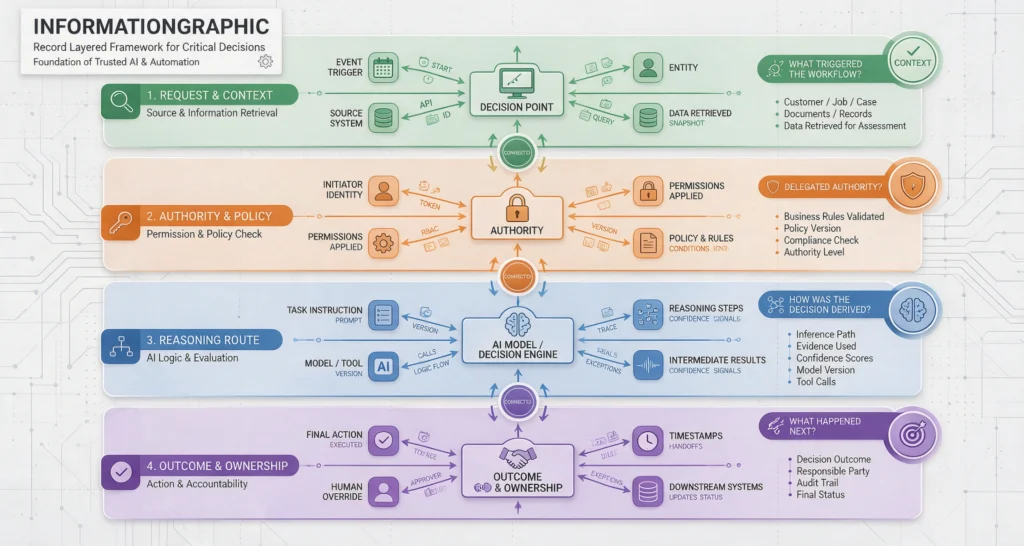
A useful audit trail follows the decision, not merely the software event. It connects evidence across the route from input to outcome.
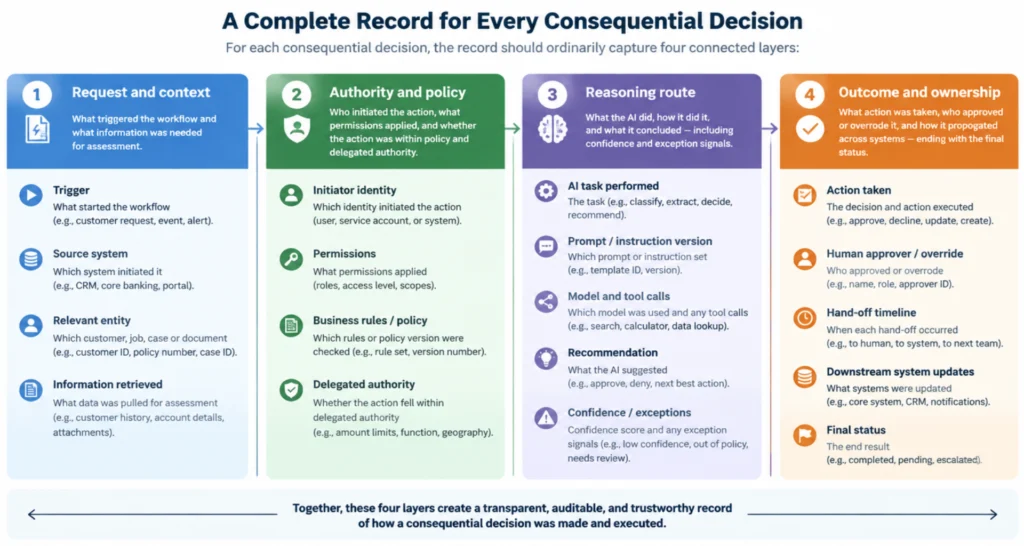
For each consequential decision, the record should ordinarily capture four connected layers:
- Request and context: what triggered the workflow, the source system, the relevant customer, job, case or document, and the information retrieved for assessment.
- Authority and policy: which identity initiated the action, what permissions applied, which business rules or policy version were checked, and whether the action fell within delegated authority.
- Reasoning route: the AI task performed, the prompt or instruction version, model and tool calls where relevant, the recommendation produced, and any confidence or exception signals.
- Outcome and ownership: the action taken, the human approver or override, the time of each hand-off, downstream system updates, and the final status.
The level of detail depends on the workflow. Storing every intermediate model token rarely improves governance and can create unnecessary cost, privacy exposure and noise. Recording a decision summary, the source references used, the applicable rule set and the approval outcome is usually more useful. Where regulation, safety or contractual obligations demand deeper traceability, retain the additional artefacts needed to reconstruct the route.
The distinction is practical. A record saying “job reassigned” leaves a manager guessing. A record saying “job reassigned because the original technician became unavailable, the replacement held the required certification, travel time met the SLA threshold, and the dispatcher approved the exception” supports review, customer communication and continuous improvement.
Design decision boundaries before selecting tools
An audit trail cannot repair an unclear operating model. Before connecting agents, models and enterprise systems, define the route a request is allowed to take.
Start with the decision itself. Is the AI permitted to retrieve, classify, draft, recommend, execute, or only prepare work for approval? These are different levels of authority. A system can autonomously categorise low-risk email and create a service ticket while requiring a team lead to approve a credit adjustment or a customer-facing commitment.
Then define the boundaries. The workflow should know when to stop because information is missing, the request falls outside policy, confidence is low, an amount exceeds a threshold, or a protected record is involved. A good exception route is not a failure of automation. It is evidence that the system recognises the limit of its authority.
Human approval should be specific rather than ceremonial. The reviewer needs the relevant context, the proposed action, the reason it was proposed and the consequences of approval. Requiring someone to click approve without this evidence only transfers risk to a person who cannot reasonably exercise judgement.
LET’S BUILD WHAT’S NEXT
Make your next move
an intelligent one.
Tell us where the bottlenecks are. Let’s explore what AI can do for your business.
Build the record into the workflow
The strongest implementations capture evidence as work moves, rather than attempting to assemble it after the fact from fragmented logs. This is where orchestration matters.
A typical route begins when a request enters through an inbox, form, CRM, service desk or internal application. The orchestration layer creates a unique decision record, identifies the requester and retrieves only the context needed for the task. It then checks policy and permissions before allowing an AI agent or connected tool to proceed.
Each significant event appends to the same record: source documents consulted, policies checked, recommendation generated, approval requested, action executed and result returned from the destination system. If the process uses multiple agents, each agent should have a defined role and a limited authority. One agent may gather information, another may assess eligibility, and a third may draft communication. None should silently exceed its assigned boundary.
Model Context Protocol integrations can help establish a controlled route to internal tools and data. The governance question remains the same: which agent may access which system, for what purpose, under what identity, and with what evidence recorded? Connection without controls simply makes a fast system capable of making a fast mistake.
The record should be easy to inspect by the people who run the process. That often means a view inside an existing service desk, CRM or operational dashboard rather than a separate technical console. A manager reviewing an exception should not need to search five platforms or ask an engineer to interpret raw event data.
Keep the trail useful, secure and proportionate
Auditability has trade-offs. Capturing too little leaves the organisation unable to explain an outcome. Capturing too much can expose sensitive data, increase storage costs and make review impractical.
Set retention periods based on the business purpose and applicable obligations. Restrict access by role. Redact or avoid storing sensitive material when a reference, classification or approved summary will do. If a source document must be retained, record who accessed it and why. The audit trail itself can become a sensitive operational asset, so it needs the same access discipline as the systems it describes.
Version control is equally important. Policies change. Prompt instructions change. Approval thresholds change. If the trail does not identify the version in force at the time, teams cannot fairly assess whether a past decision followed the intended rule.
Measure where decisions break down
Once decision evidence is available, it becomes an operational improvement tool. Leaders can see which exceptions recur, which approvals wait too long, where staff frequently override recommendations, and which source systems provide incomplete context.
High override rates do not automatically mean the AI is poor. They may indicate an unclear policy, unreliable source data or an approval boundary set too conservatively. Conversely, a very low override rate is not proof that a process is healthy if reviewers are approving work without meaningful inspection. Review both the outcome and the quality of the decision route.
This is where accountable automation earns its value. Instead of asking whether an AI tool is impressive, teams can ask whether it reduced handling time, improved response consistency, protected decision authority and produced evidence that stands up to review.
At SpeedOz, this approach treats automation as an accountable operating route: capture the request, connect the right context, check policy, obtain approval where needed, coordinate the action and record the outcome. The objective is not to make people disappear from consequential work. It is to give them better control over more work.
A well-designed trail gives leaders permission to automate with confidence. When every important decision has a clear route, a named owner and inspectable evidence, progress does not depend on trust in a black box. It depends on a system people can verify.