

A job lodged at 4.45 pm should not sit in an inbox until someone notices it the next morning. Yet that is still how many operational delays begin: a customer request arrives, a document is missing, an approval is unclear, and the next person in the chain has no context.
A multi-agent systems business approach addresses this problem by assigning AI agents clear operational roles, connecting them to the right systems, and setting firm boundaries around what they can do. The value is not a collection of clever chatbots. It is a controlled route from request to recorded outcome.
For Australian organisations managing fragmented software, growing service volumes and lean teams, this can create capacity without handing consequential judgement to a model.
What multi-agent systems mean for business
A multi-agent system is a coordinated group of specialised AI agents. Each agent has a defined purpose, permitted data sources, approved actions and escalation rules. One may interpret an incoming request. Another may retrieve account, job or case context. A third may check policy. A fourth may prepare a response or create a task in the relevant platform.
The distinction matters. A single general-purpose assistant can be useful for drafting or answering questions. It becomes less reliable when it is expected to understand every process, access every system and make every decision. Specialisation narrows the task, reduces ambiguity and makes performance easier to inspect.
In an operational setting, an orchestrator coordinates the route. It determines which agent should act next, passes only the required context, checks whether conditions have been met and records evidence at each decision boundary. Human approval remains part of the route where risk, judgement or authority demand it.
Think of a field service request. A triage agent classifies the issue and extracts the site, asset and urgency. A context agent checks the CRM, service history and technician availability. A policy agent tests whether the customer is covered by contract and whether an emergency call-out needs approval. The system can then propose a booking, send the right communication and create the work order. If the job is outside scope or the cost exceeds a threshold, it stops and routes the matter to an authorised person.
That is orchestration, not autonomous improvisation.
The business case is operational capacity
The strongest case for multi-agent systems is rarely headcount reduction alone. It is the removal of waiting, rekeying, chasing and context switching from work that still requires people at the right moments.
Professional services firms often lose time turning meeting notes, emails and attachments into a complete matter record. Healthcare administration teams spend hours checking referral completeness, locating documentation and following up on missing information. Field service teams deal with delayed dispatch because customer details, technician schedules and asset records sit in separate systems.
A well-designed agent route can capture the request, retrieve relevant information, identify gaps, apply rules and prepare the next action in seconds. Staff then review exceptions, apply professional judgement and deal with customers rather than moving data between tabs.
The measurable outcomes are usually straightforward: faster first response, fewer incomplete submissions, reduced turnaround time, improved job conversion, lower rework and better visibility of work in progress. The right baseline varies by operation. A high-volume service desk may focus on ticket ageing. A clinic may focus on referral processing time and administrative exceptions. A consultancy may focus on the time from enquiry to a qualified proposal.
It depends on where work is currently blocked. Automating a fast step with no downstream constraint produces little value. Improving the hand-off that holds up an entire process can change the capacity of the whole team.
LET’S BUILD WHAT’S NEXT
Make your next move
an intelligent one.
Tell us where the bottlenecks are. Let’s explore what AI can do for your business.
Design the route before selecting agents
Businesses often begin with a tool demonstration and work backwards. That approach can create impressive prototypes that fail when exposed to real permissions, edge cases and accountability requirements.
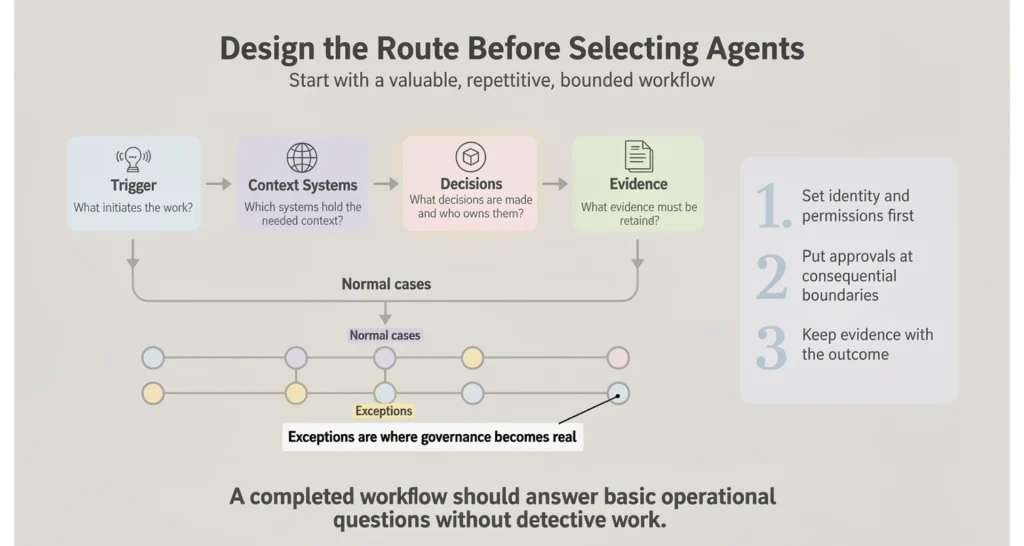
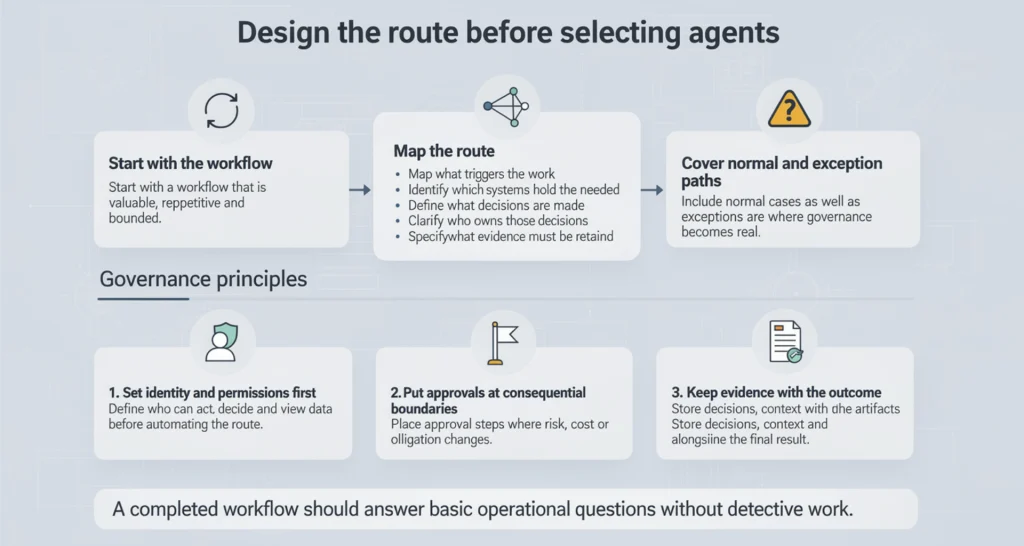
Start instead with a workflow that is valuable, repetitive and bounded. Map what triggers the work, which systems hold the needed context, what decisions are made, who owns those decisions and what evidence must be retained. The route should include normal cases as well as exceptions. Exceptions are where governance becomes real.
Set identity and permissions first
Every agent needs an identity. The system should be able to show which agent accessed which source, what it was permitted to read or change, and under whose authority it acted. An agent that can draft a customer response does not automatically need permission to amend a contract or issue a refund.
This is particularly relevant where tools have accumulated over time. CRMs, ERPs, inboxes, document repositories, scheduling platforms and internal applications often carry different access models. Connecting them without a permission design creates a larger attack surface and unclear responsibility.
Model Context Protocol, or MCP, can provide a structured way for agents to use approved tools and data sources. But the protocol is not the governance model. The business still needs to define which actions are available, when they can be used and how those actions are logged.
Put approvals at consequential boundaries
Not every action needs a human review. Requiring approval for routine data retrieval or a standard acknowledgement can simply recreate the delay the system was meant to remove. Equally, allowing an agent to approve a clinical exception, change pricing or commit contractual terms is usually inappropriate.
The practical question is: what happens if this decision is wrong? If the impact is material, irreversible, regulated or customer-sensitive, the system should prepare a recommendation and request approval. The approver needs enough context to make a decision quickly, including source records, policy checks, the proposed action and a clear reason for escalation.
Good approval design protects both speed and accountability. People should not be asked to rubber-stamp vague AI output. They should receive an evidence-backed decision packet at the point their judgement adds value.
Keep evidence with the outcome
A completed workflow should answer basic operational questions without detective work. What triggered the action? Which information was used? What policy or rule was applied? Who approved the exception? What changed in each connected system?
This record is useful beyond compliance. It helps teams investigate complaints, improve policies, identify recurring failure points and measure whether the route is producing the intended result. It also gives leaders a way to distinguish a genuine operational system from an opaque automation layer.
Where multi-agent systems business deployments fail
The most common failure is giving agents a vague brief such as “handle customer enquiries” or “automate administration”. Broad instructions invite inconsistent interpretation. An agent needs a defined outcome, an approved set of actions and a known escalation path.
Another failure is treating source data as trustworthy because it exists in a system. Customer records may be duplicated, asset details may be outdated and document names may conceal the wrong version. Agents can surface these weaknesses quickly, but they cannot resolve unclear data ownership by themselves. A deployment should include data quality checks and a nominated owner for each critical record.
There is also a temptation to measure success through activity: how many requests an agent processed or how many messages it drafted. Those figures are useful, but they do not prove business value. Track the operational measure that justified the work, such as reduced time to dispatch, fewer abandoned enquiries or less manual follow-up per referral.
Finally, avoid designing for full autonomy on day one. Begin with a controlled route where the system recommends, drafts, retrieves and coordinates. Review actual exceptions and failure patterns. Expand permissions only when the evidence supports it.
A practical first deployment
A sensible first deployment usually centres on one cross-system workflow with a visible bottleneck. Choose a process that has enough volume to show a result, clear rules for standard cases and a responsible business owner who can make timely decisions about exceptions.
For example, an enquiry-to-appointment route might capture web and email enquiries, identify the service required, retrieve customer history, check eligibility, propose available times and create a follow-up task. The system can escalate incomplete information, unusual requests and any decision that affects pricing or service suitability.
Before implementation, agree on the baseline: current response time, completion rate, manual touches and common exception types. Then test the route with real but controlled cases. Staff feedback matters here. The people performing the work will identify missing context, policy nuances and customer scenarios no process diagram fully captures.
The aim is not to replace operational ownership. It is to give teams a better route through the work, with less friction and clearer evidence.
The organisations that get lasting value from multi-agent systems treat them as part of their operating model. They define the decision boundaries first, connect the systems that matter, and let people retain authority where judgement carries consequence. That is how AI becomes a useful colleague in the workflow rather than another system staff need to manage.