

A service coordinator receives an urgent after-hours request. An AI agent can read the email, identify the customer, check the service agreement, find a qualified technician and prepare a job. The critical question is not whether it can do those things. It is whether it should dispatch work, commit a cost or contact a customer without the right authority.
That question sits at the centre of AI control trends 2026. For Australian businesses, the next stage of AI adoption will be less about producing impressive answers and more about directing real work through connected systems without losing accountability. The useful systems will not simply converse. They will operate within defined routes: access the right context, apply policy, request approval where needed, perform an authorised action and leave evidence behind.
AI control trends 2026: governance moves into the workflow
For many organisations, AI governance still lives in a policy document, a procurement questionnaire or a risk register. Those artefacts matter, but they do not control what happens when an agent reads a mailbox, updates a CRM record or triggers a payment workflow.
In 2026, governance will increasingly become operational. Controls will sit at decision boundaries, not only at the start of a project. A system will need to establish who requested an action, what data it may access, which policy applies, whether the action is reversible and who must approve it.
This is a material change from the chatbot era. A chatbot can produce an inaccurate response with limited consequence. An agent connected to scheduling, finance, documents and customer communications can create a chain of consequences quickly. The more useful the agent becomes, the more clearly its authority must be defined.
A practical route might look like this: capture a service request, retrieve the relevant customer and asset context, check contract terms, prepare a recommendation, seek a coordinator’s approval for non-standard work, create the job and record why the decision was made. Each stage has a purpose. Each can be inspected later.
Identity becomes the first control, not an afterthought
The question “what can this AI do?” is incomplete. The better question is “what can this AI do for this person, in this situation, through this system?”
Identity controls will become more granular as organisations connect AI to operational platforms. An accounts officer, a field supervisor and an external contractor should not receive the same AI access simply because they use the same assistant. Their entitlements, data visibility and approval limits differ. The agent must respect those differences.
This also applies to machine identity. Every agent, integration and automation route needs an accountable identity with defined permissions. Shared credentials and broad administrator access may be expedient during a pilot, but they make evidence weak and incident response difficult once automation reaches production.
For a professional services firm, an AI agent may be permitted to assemble a client matter summary from approved sources but not send advice externally. In healthcare administration, it may classify incoming referrals and prepare documentation but escalate clinical ambiguity to a qualified person. In field service, it may recommend a technician and appointment window but require approval before overriding a service-level commitment.
The control is not a brake on value. It is what permits the organisation to use the system in consequential work.
Permissioned context will matter more than bigger prompts
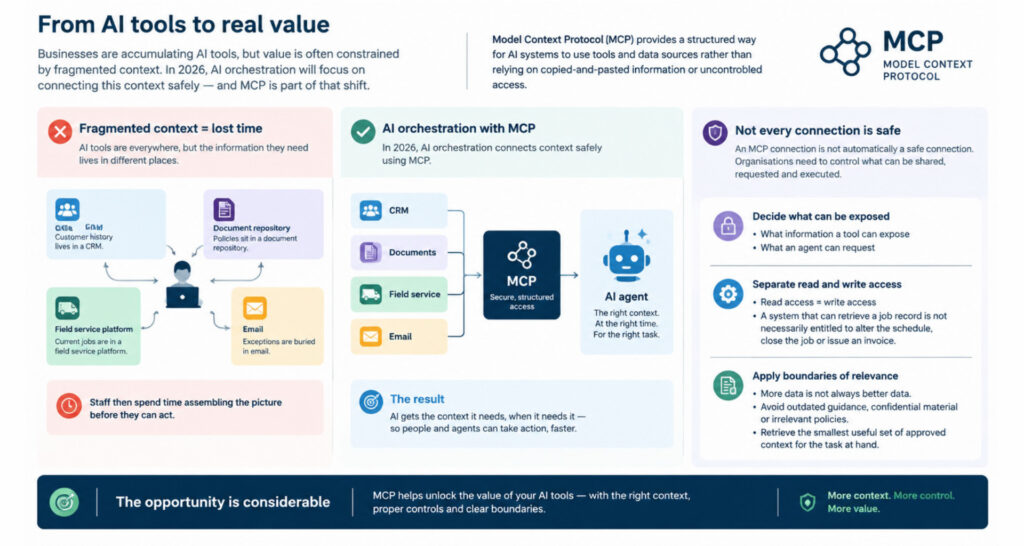
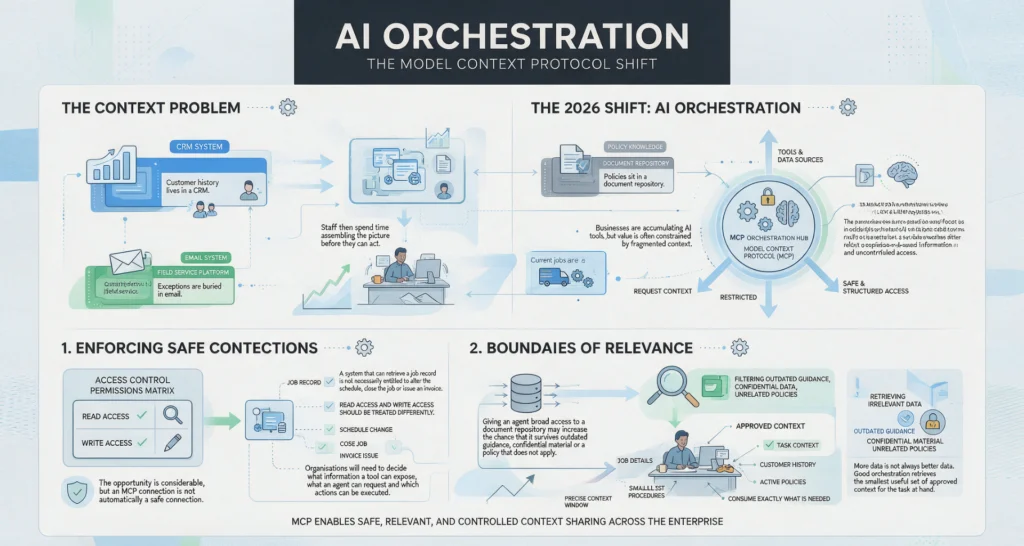
Businesses are accumulating AI tools, but value is often constrained by fragmented context. Customer history lives in a CRM. Policies sit in a document repository. Current jobs are in a field service platform. Exceptions are buried in email. Staff then spend time assembling the picture before they can act.
In 2026, AI orchestration will focus on connecting this context safely. Model Context Protocol, or MCP, is part of this shift. It provides a structured way for AI systems to use tools and data sources rather than relying on copied-and-pasted information or uncontrolled access.
The opportunity is considerable, but an MCP connection is not automatically a safe connection. Organisations will need to decide what information a tool can expose, what an agent can request and which actions can be executed. Read access and write access should be treated differently. A system that can retrieve a job record is not necessarily entitled to alter the schedule, close the job or issue an invoice.
Context also needs boundaries of relevance. More data is not always better data. Giving an agent broad access to a document repository may increase the chance that it surfaces outdated guidance, confidential material or a policy that does not apply. Good orchestration retrieves the smallest useful set of approved context for the task at hand.
LET’S BUILD WHAT’S NEXT
Make your next move
an intelligent one.
Tell us where the bottlenecks are. Let’s explore what AI can do for your business.
Approval design will become a competitive capability
Human approval is often described as a fallback for when AI fails. That framing is wrong. Approval is a deliberate design choice for decisions where commercial judgement, professional duty, customer impact or risk tolerance belongs to people.
The trend for 2026 is not to place a human in every step. That merely recreates manual work with extra screens. It is to place human authority at the points where it changes the outcome.
A useful approval design considers value, reversibility and exception rate. A low-value, reversible action such as creating an internal task may proceed automatically if confidence and policy conditions are met. A high-value quote, a non-standard discount, a customer-facing clinical communication or an external legal statement should take a different route.
Approvals should arrive with context, not just a button. The reviewer needs the source information, the proposed action, the policy basis, any uncertainty and the practical consequence of approving or declining. This reduces review time while preserving accountable judgement.
There is a trade-off. Too many approvals create queues and encourage staff to rubber-stamp. Too few create unmanaged exposure. The right threshold depends on the workflow, the customer promise and the organisation’s appetite for risk. It should be tested against actual operational data, then adjusted.
Evidence will be expected, not optional
When an AI-assisted decision is challenged, the organisation needs more than a final output. It needs an inspectable record of what happened.
In practice, evidence should show the request, the identity involved, the data sources consulted, the policy or rule applied, the recommendation made, the approval decision and the action completed. Where the system could not proceed, it should also record the reason for escalation.
This is valuable beyond compliance. It helps operations leaders find bottlenecks, identify recurring exceptions and improve the underlying process. If a scheduling agent repeatedly seeks approval for the same type of job, that may point to an unclear service rule rather than an AI problem.
Evidence also creates a more productive relationship between operational teams and technology teams. Rather than debating whether the AI is generally trustworthy, they can review specific routes, decisions and outcomes. That is a far better basis for iteration.
Multi-agent systems will require clear operating boundaries
Specialised agents are likely to take on distinct roles: one gathers information, another checks policy, another prepares a customer response and another executes an approved update. This can improve reliability because each agent has a narrower task and defined inputs.
However, multiple agents do not remove governance complexity. They distribute it. Without careful orchestration, one agent can make an assumption that another treats as fact, while no single owner can explain the final action.
The operating model needs a clear coordinator, controlled hand-offs and rules about what each agent may assert, retrieve or execute. A policy-checking agent should not silently become an approval authority. A drafting agent should not gain the ability to send messages because a downstream tool connection happens to permit it.
For growing businesses, the sensible starting point is usually one high-friction workflow with measurable volume, known exceptions and a clear process owner. Build the route, controls and evidence around that workflow first. Expansion should follow demonstrated capacity gains, not enthusiasm for adding agents.
Control will be measured by operational outcomes
The strongest AI programmes in 2026 will not report success through model usage alone. They will measure time to resolution, rework, exception volume, approval turnaround, customer response speed and the proportion of work completed within policy.
These measures reveal whether the system is genuinely helping. If an agent processes more requests but generates a rising number of corrections, it has moved effort rather than removed it. If approvals become faster because reviewers receive better context, that is a meaningful capacity gain.
SpeedOz approaches AI automation as an accountable operating route because this is where durable value sits. Connected systems matter, but so do clear boundaries. An AI system should make work move faster without making responsibility disappear.
The businesses that benefit most will not be those that hand the most decisions to AI. They will be those that decide, with discipline, where automation can act freely, where people must remain in charge and what evidence both need to work with confidence.