

A service coordinator receives an urgent job request at 4:45 pm. The system can read the email, identify the customer, check the asset history, assess technician availability and prepare a work order. But should it promise a response time, approve an after-hours surcharge, or dispatch a contractor without review? AI decision boundaries answer those questions before a fast workflow becomes an expensive mistake.
The value of AI automation is not that it performs every task without people. It is that routine work moves quickly, while consequential decisions remain owned by the right person. A well-designed operating route makes that distinction explicit. It captures the request, gathers context from connected systems, checks policy, routes exceptions for approval, acts within permission, and records what happened.
For Australian businesses managing fragmented systems, this is the difference between an AI experiment and an accountable operational capability.
What AI decision boundaries actually define
A decision boundary is the point at which an AI system must either stop, seek approval, apply a defined rule, or hand work to another system or person. It governs authority, not just technology.
Many teams begin automation with a question such as, “Can the AI do this?” The better question is, “Under what conditions may it do this, using which information, with what evidence, and who owns the outcome?” That shift matters because most business processes contain decisions of different consequence.
An agent may be permitted to classify an inbound request, extract details from a PDF, draft a customer reply, create a CRM record or schedule a standard follow-up. Those are often low-risk, reversible actions. The same agent may need approval before issuing a refund, changing a patient appointment, accepting contract terms, committing stock, approving a quote outside margin rules, or sending sensitive information externally.
The boundary should reflect the actual operational risk. It should not be a blanket rule that every AI action needs human approval. That creates queues, removes the capacity benefit and encourages staff to work around the system. Nor should it be a blanket rule that the model can proceed whenever it appears confident. Model confidence is not business authority.
Boundaries turn workflows into accountable routes
A useful AI workflow has a clear route. Consider a professional services firm processing a new client enquiry. The system can capture the message, identify the organisation, search the CRM for existing relationships, extract the requested service and prepare a response using approved material.
At that point, policy determines the next move. If the enquiry is within a standard service scope, from an approved geography and contains no conflict indicators, the system may send a meeting link and create an opportunity. If it identifies a potential conflict, a regulated matter, an unusual fee request or missing information, it pauses and routes the case to a nominated person.
That route is more useful than an open-ended chatbot because it has defined inputs, permissions and outcomes. The AI is not improvising how the firm operates. It is coordinating work within a designed operating model.
The same pattern applies in healthcare administration. An AI agent can collect referral information, identify missing fields, prepare correspondence and update a practice system. It should not independently make clinical judgements, alter treatment information or release records outside defined permissions. In field service, it can triage a fault report and prepare dispatch options, while a duty manager retains authority for safety-critical allocation or costly emergency work.
The five controls behind a sound boundary
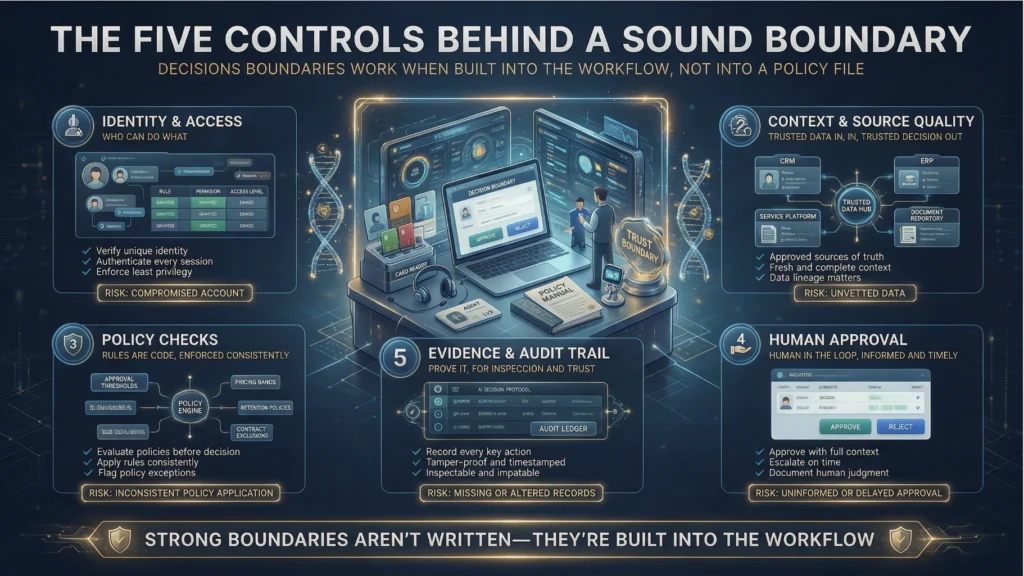
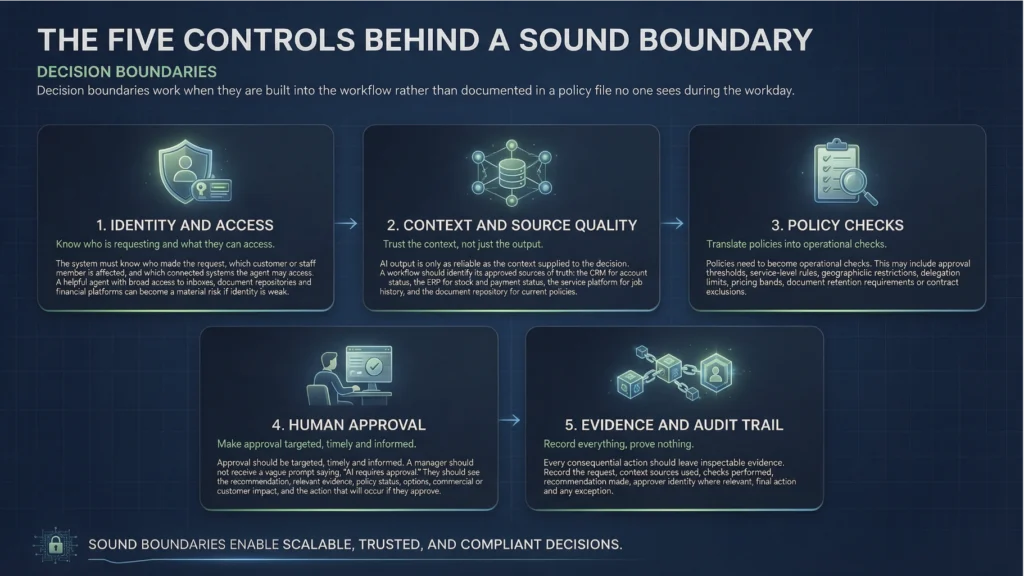
Decision boundaries work when they are built into the workflow rather than documented in a policy file no one sees during the workday. In practice, five controls matter most.
Identity and access
The system must know who made the request, which customer or staff member is affected, and which connected systems the agent may access. A helpful agent with broad access to inboxes, document repositories and financial platforms can become a material risk if identity is weak.
Permissions should be specific to the role and task. An agent preparing a quote may read product data and pricing rules, but not change master pricing. An agent handling service requests may update a ticket, but not access unrelated HR documents. This is especially relevant where MCP server integrations connect models to enterprise tools. Connection is not permission. Each tool action needs a defined scope.
Context and source quality
AI output is only as reliable as the context supplied to the decision. A workflow should identify its approved sources of truth: the CRM for account status, the ERP for stock and payment status, the service platform for job history, and the document repository for current policies.
Where records conflict or key data is absent, the correct action may be to ask for clarification or escalate. The system should not fill a gap with a plausible assumption and then trigger a customer commitment. Good orchestration treats uncertainty as a route condition.
Ready to get started?
A one-line nudge that earns the click below.
Policy checks
Policies need to become operational checks. This may include approval thresholds, service-level rules, geographic restrictions, delegation limits, pricing bands, document retention requirements or contract exclusions.
Some policy checks are deterministic and can be executed directly. Others require judgement. A workflow can automatically approve a standard replacement part under an agreed value, but it may need a manager to assess whether an exception is commercially sensible. The aim is not to force judgement into a rigid rule. It is to ensure the system recognises when judgement is required.
Human approval
Approval should be targeted, timely and informed. A manager should not receive a vague prompt saying, “AI requires approval.” They should see the recommendation, relevant evidence, policy status, options, commercial or customer impact, and the action that will occur if they approve.
This reduces approval fatigue and makes ownership real. It also creates a useful feedback loop. When approvers regularly override a recommendation, the team can examine whether the policy, data, workflow design or model instructions need adjustment.
Evidence and audit trail
Every consequential action should leave inspectable evidence. Record the request, context sources used, checks performed, recommendation made, approver identity where relevant, final action and any exception.
This is not administration for its own sake. It allows operations leaders to investigate an outcome, demonstrate control, improve processes and answer a customer or regulator with facts. Evidence also makes it easier to distinguish a model issue from a data issue, an integration failure or an unclear business rule.
How to set boundaries without slowing the business
Start with a real workflow, not a generic AI capability. Map how a request enters the business, where information is gathered, which systems are touched, where staff make decisions and what a poor outcome would cost. The most valuable opportunities are often high-volume administrative routes with clear rules and recurring hand-offs.
Then separate actions into three practical categories. The first is autonomous: the system can proceed and record the outcome. The second is conditional: it can act only when defined checks pass. The third is approval-led: it can prepare the work, but a person must authorise the final step. These categories should be reviewed by the operational owner, not decided solely by an IT team or software vendor.
Define exception paths early. Exceptions are not proof that automation failed. They are proof that the route recognises its limits. A well-designed system knows whether to request missing information, create a review task, notify a duty manager or stop an action entirely.
Finally, measure what changes. Look beyond time saved. Track response times, rework, approval volumes, exception rates, customer outcomes, missed hand-offs and the proportion of work completed without manual chasing. These measures show whether the boundary is calibrated. If approvals are overwhelming the team, the rules may be too broad. If exceptions are rare but costly, the system may be proceeding too freely.
Boundaries are not barriers to useful AI
Some leaders worry that governance will make automation slow and difficult to deploy. Poor governance can do that, particularly when controls are added late and applied indiscriminately. Clear decision boundaries do the opposite. They let teams automate confidently because everyone understands where the system has authority and where people retain it.
For SpeedOz, that is the practical purpose of orchestration: connected systems, clear routes and evidence at every consequential hand-off. AI can handle the repeatable work at pace. People can focus on exceptions, relationships and professional judgement.
The best boundary is not the strictest one. It is the one that lets ordinary work move without friction while making exceptional work visible before it creates risk.