A customer asks for a service booking. A staff member needs a proposal prepared. An invoice arrives without a purchase order. In each case, a chatbot can provide an answer. An AI agent can potentially move the work forward. That distinction matters far more than the interface.
When comparing AI agents versus chatbots, the useful question is not which technology sounds more advanced. It is whether the system can take the right action, through the right route, with the right permissions and evidence. For growing businesses, that is the difference between a helpful digital front door and an operational capability.
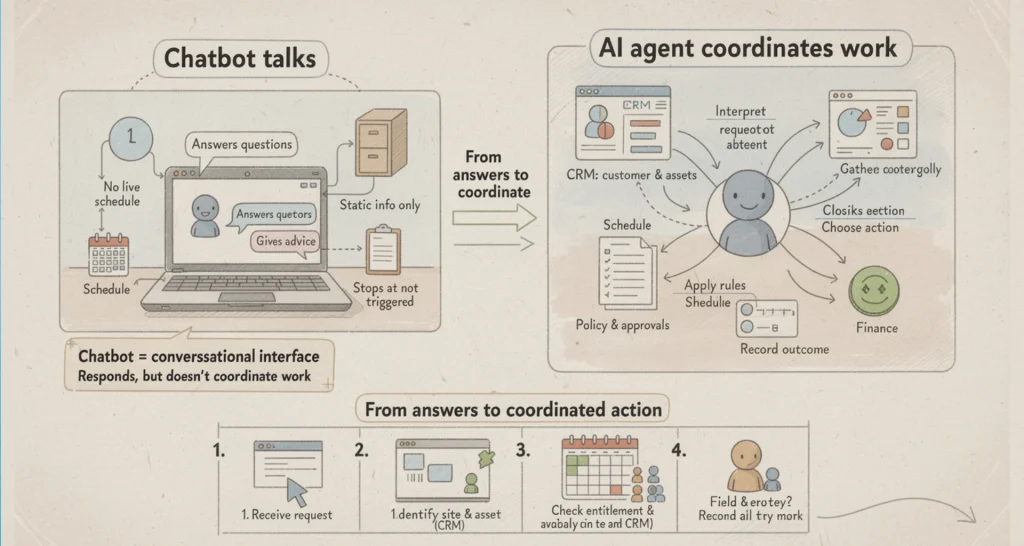
A chatbot talks. An AI agent coordinates work.
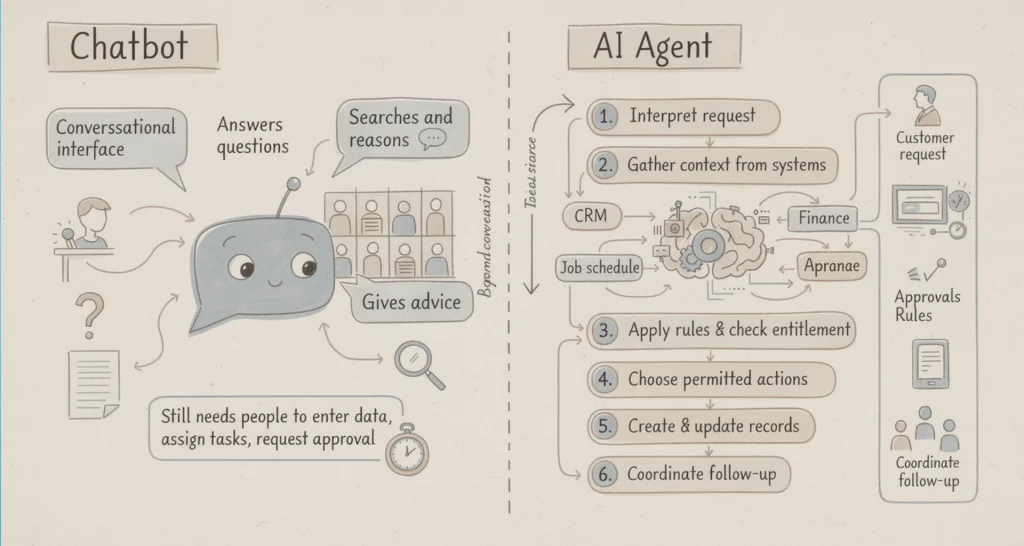
A chatbot is primarily a conversational interface. It receives a question, searches or reasons over available information, and returns a response. It may answer policy questions, guide a customer through a process, qualify an enquiry, or help an employee find a document. These are valuable jobs, particularly when the same questions consume team time every day.
But a chatbot does not necessarily know whether its answer should trigger work elsewhere. It may not have access to the live job schedule, the CRM record, the finance system or the approval policy. Even where it can retrieve information, it commonly stops at the point of advice: a person still needs to enter data, assign a task, request approval and follow up.
An AI agent is designed around a goal and a route to achieve it. It can interpret a request, gather relevant context from connected systems, apply defined rules, choose from permitted actions, and record what happened. It may still communicate through a chat window, email or a web form. The interface is not the defining feature. The ability to coordinate governed action is.
For example, a field service agent could receive a customer request, identify the site and asset from the CRM, check entitlement and technician availability, propose appointment options, create a draft work order, and send an approval request if the job falls outside the agreed service scope. Every step can be visible and bounded.
That is not a chatbot with extra prompts. It is an operational route.
AI agents versus chatbots: the practical differences
The overlap can make procurement confusing. Both may use large language models. Both can appear in a familiar chat interface. Both can reduce repetitive work. The meaningful differences sit behind the conversation.
Context is connected, not merely recalled
A chatbot may be trained on a knowledge base or given access to selected documents. That is suitable for stable information such as procedures, product details and standard answers. Its context is often read-only and broad.
An agent needs situational context. It may need the current account status, job history, contract terms, stock availability, open support cases and the identity of the person making the request. It should retrieve this context from the systems that own it rather than rely on copied data or a model’s memory.
This is where integrations matter. A well-designed integration layer, including Model Context Protocol (MCP) servers where appropriate, gives an agent controlled ways to inspect and act across business systems. The agent does not need unrestricted access to everything. It needs the minimum context and tools required for its route.
Action follows policy
Chatbots generally respond with information or suggestions. Agents can execute actions, but execution must be governed. Sending a routine confirmation is different from changing a customer contract, approving a refund or booking a clinical appointment. Treating both actions as equally safe creates avoidable risk.
A disciplined agent design establishes decision boundaries before implementation. It defines which actions are automatic, which require a human approval, which are prohibited, and what evidence must be captured. The result is not less useful automation. It is automation that can operate safely at greater scale.
Consider an accounts workflow. An agent can extract invoice details, match them against a purchase order and receipt, identify exceptions, and prepare a payment recommendation. If values and match confidence fall within policy, the item may proceed to the next authorised stage. If terms conflict or the invoice exceeds a threshold, the agent routes it to the right person with the supporting evidence attached.
The human retains authority over consequential decisions. The system removes the chasing, copying and sorting around those decisions.
Outcomes are inspectable
A good chatbot conversation can be reviewed, but that is not the same as operational traceability. When an agent changes a record, assigns work or triggers a customer message, a business should be able to see what context informed the action, which policy was checked, who approved an exception and where the result was recorded.
This evidence is especially relevant in healthcare administration, professional services and regulated workflows. It is also useful in ordinary commercial operations. If a customer disputes a change, or a manager asks why a job was prioritised, the answer should not be that the AI decided. There should be an inspectable route.
When a chatbot is the better choice
Not every problem needs an agent. A chatbot is often the right starting point when the work is primarily informational and the cost of an imperfect response is low. Internal policy guidance, website enquiry capture, after-hours FAQs and basic employee support are common examples.
The key is to set expectations accurately. A chatbot can reduce friction and improve response speed, but it will not fix fragmented hand-offs by itself. If staff still need to manually locate records, re-key information and chase approvals after every conversation, the underlying workflow remains unchanged.
A chatbot is also sensible when a process is not yet stable. If teams disagree on the current process, exceptions are unmanaged, or ownership is unclear, automating action too early can simply make confusion faster. Map the work first. Identify the actual decision-makers, systems of record and exceptions.
When an AI agent earns its place
An agent becomes worthwhile where work repeatedly crosses systems, teams or decision points. The strongest candidates are not necessarily the most glamorous. They are high-volume processes where people spend time collecting context, applying routine checks, creating updates and following up on stalled work.
Look for workflows with four characteristics:
- A clear trigger, such as a new enquiry, submitted form, inbox message or service request.
- Reliable source systems that hold the information needed to progress the work.
- Repeatable policies that distinguish ordinary cases from exceptions.
- A measurable business outcome, such as faster response, fewer manual touches, improved conversion or reduced rework.
For a professional services firm, an agent might capture an enquiry, identify the relevant service line, check client status in the CRM, prepare an engagement intake, and route conflicts or pricing exceptions for review. For a healthcare administrator, it might check referral completeness, request missing information, prepare booking options and escalate clinical or privacy-sensitive issues. For a field service business, it might coordinate scheduling, customer updates, parts availability and job documentation.
In each case, the agent is useful because it connects action to business context. It is not useful merely because it can generate polished text.
The implementation question is governance, not autonomy
The word agent can encourage an unhelpful idea: give software a broad objective, turn it loose, and hope it works. That is not how accountable operations are built.
A practical implementation starts with one workflow and makes its route explicit. Capture the request. Connect the relevant context. Check policy. Obtain approval where authority is required. Coordinate the permitted actions. Record the outcome. Then measure what changed: turnaround time, manual effort, exception rate, conversion, backlog or service quality.
Permissions should be specific. An agent may draft a customer email but not send it. It may create a job record but not alter pricing. It may recommend an action but require manager approval to commit it. These boundaries can evolve as evidence builds and confidence increases.
Multi-agent systems can be appropriate for more complex operations, where specialised agents handle intake, document analysis, scheduling or follow-up. Yet more agents are not automatically better. Every added component needs a defined role, hand-off, identity and audit trail. Orchestration should reduce operational ambiguity, not introduce another layer of it.
SpeedOz approaches this work as an accountable operating route rather than a standalone AI feature. The technology matters, but the real design work is deciding what the system may do, what it must prove, and when people must decide.
Choose the capability that matches the work
The choice between a chatbot and an AI agent is rarely permanent. A useful chatbot can become the conversational entry point to an agent-led workflow once the process, integrations and controls are ready. Equally, an agent may use a chatbot only as one channel among email, forms and internal systems.
Start with the work that is creating friction now. If people mainly need answers, build for trusted conversation. If they need work to move across disconnected systems without losing control, design an agent route with clear boundaries. The best next step is the one your team can inspect, govern and improve after it goes live.