

A referral arrives without a Medicare detail. A patient cancellation creates an unfilled appointment. A clinician finishes a consult, but the documentation, billing check and follow-up task sit in three separate systems. These are not isolated admin issues. They are operational hand-offs where delays, omissions and unclear ownership compound quickly.
To automate healthcare administration workflows, AI needs more than a chat interface attached to an inbox. It needs access to the right context, clear authority limits, policy checks at the right points and a record of what happened. The objective is not to remove people from healthcare administration. It is to remove unnecessary chasing, copying, re-keying and status checking so people can focus on work that requires judgement.
Where AI automation creates practical capacity
Healthcare administration is full of repeatable routes. Requests arrive through phones, portals, email, forms and internal queues. Staff then identify the patient, locate the relevant record, verify information, apply a policy, update systems and notify the next person. Much of that work is necessary. The fragmented movement between tools is not.
AI orchestration can coordinate these routes across practice management software, CRMs, inboxes, document repositories, billing systems and service desks. A system can read an incoming referral, extract the required fields, identify missing information, create a work item and prepare the appropriate response. It can also route the exception to the correct team member rather than leaving it in a shared inbox.
The value is usually found in the volume of small decisions around the clinical encounter, not in replacing clinical decision-making. Suitable starting points include referral intake, appointment readiness, waitlist management, claims preparation, document classification, consent follow-up and patient communications that follow approved templates.
A useful test is simple: if a capable administrator repeatedly gathers the same information, applies a stable rule and updates several systems, there is likely an automation opportunity. If the task requires interpreting a complex patient circumstance, exercising clinical judgement or making an exception with significant consequences, the system should prepare the work and seek approval.
Automate healthcare administration workflows with boundaries
The word automate can create the wrong expectation. In healthcare, the best operating model is rarely full autonomy. It is controlled progression: capture a request, connect relevant context, check the applicable policy, ask for approval where needed, coordinate the next action and record the outcome.
Consider a referral management route. An AI-enabled workflow can receive a referral from a secure channel, classify the document type, extract contact and referral details, check whether mandatory information is present, search for potential duplicate records and create a draft entry in the practice system. Where the information meets defined requirements, it can assign the referral to the appropriate queue and send a pre-approved acknowledgement.
Where anything is uncertain, the route should stop. A missing identifier, ambiguous urgency indicator, conflicting patient details or out-of-policy request becomes an exception for a nominated staff member. The system should show the source document, the fields it extracted, the rule it applied and the reason it needs a decision. That is evidence, not black-box automation.
This distinction matters because a workflow can be fast without being careless. Staff should be able to see what the system knows, what it inferred, what it changed and what remains awaiting human action. For patient-facing actions, organisations may require approval based on message type, risk level, patient cohort or confidence threshold. Those boundaries should be designed before deployment, not added after an incident.
Start with a route, not a tool
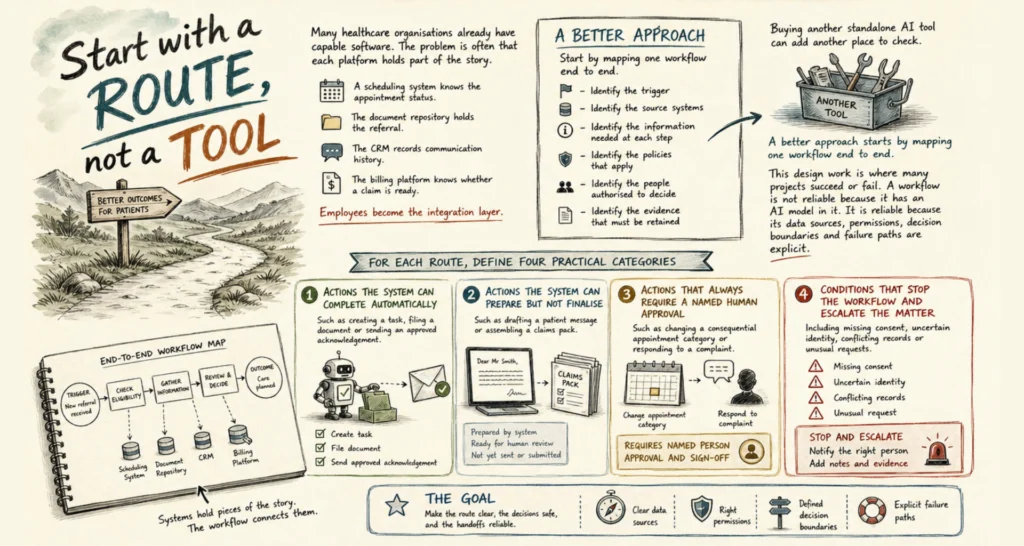
Many healthcare organisations already have capable software. The problem is often that each platform holds part of the story. A scheduling system knows the appointment status. The document repository holds the referral. The CRM records communication history. The billing platform knows whether a claim is ready. Employees become the integration layer.
Buying another standalone AI tool can add another place to check. A better approach starts by mapping one workflow end to end. Identify the trigger, the source systems, the information needed at each step, the policies that apply, the people authorised to decide and the evidence that must be retained.
For each route, define four practical categories:
- Actions the system can complete automatically, such as creating a task, filing a document or sending an approved acknowledgement.
- Actions the system can prepare but not finalise, such as drafting a patient message or assembling a claims pack.
- Actions that always require a named human approval, such as changing a consequential appointment category or responding to a complaint.
- Conditions that stop the workflow and escalate the matter, including missing consent, uncertain identity, conflicting records or unusual requests.
This design work is where many projects succeed or fail. A workflow is not reliable because it has an AI model in it. It is reliable because its data sources, permissions, decision boundaries and failure paths are explicit.
Ready to get started?
A one-line nudge that earns the click below.
Build around identity, privacy and evidence
Healthcare administration involves sensitive information, so data handling cannot be an afterthought. The system must know who is making a request, which records they are permitted to access and which downstream actions they are authorised to trigger. Role-based access, least-privilege permissions and audited service accounts are operational requirements, not compliance decoration.
The same applies to AI context. A model should receive only the information needed for its task. A document classification step does not necessarily need a full longitudinal patient record. A recall workflow may need appointment status and an approved communication template, not every clinical note. Reducing unnecessary context improves privacy posture and can improve output quality.
Every material action should leave a usable trail. That includes the source that triggered the workflow, the data used, the policy or rule applied, any approval received, the system updated and the message sent. When a patient queries a communication or an administrator needs to correct a record, the organisation should not have to reconstruct the event from scattered logs and inboxes.
For organisations connecting several systems, an integration layer can govern how agents and applications request information or take action. Model Context Protocol, or MCP, can support structured connections between AI agents and approved business systems. The technical standard is not the outcome by itself. The outcome is controlled access to context and actions, without giving a general-purpose assistant broad, unmonitored permissions.
Measure capacity before promising savings
AI automation should be justified by operational measures, not novelty. Start with the current route: how many items arrive each week, how long they wait, how many touches they require, how often information is re-entered and where exceptions accumulate. Then set measures that reflect the real problem.
For referral intake, that might mean time from receipt to triage-ready status, percentage of referrals complete on first review, and the number of referrals sitting unassigned after a service target. For appointment operations, it may be waitlist conversion, reduction in unused slots, response time to cancellations and staff time spent on manual outreach.
Do not assume every workflow should optimise for speed. A complaints route may prioritise correct escalation and complete records. A billing route may prioritise reduced rework and fewer rejected claims. The right metric depends on the risk, volume and service impact of the work.
It also depends on the quality of the underlying process. AI will expose unclear ownership, inconsistent templates and weak data standards. That can feel like a setback, but it is useful evidence. Fixing those foundations before scaling automation prevents a fast system from repeating a flawed process at greater volume.
A sensible first deployment
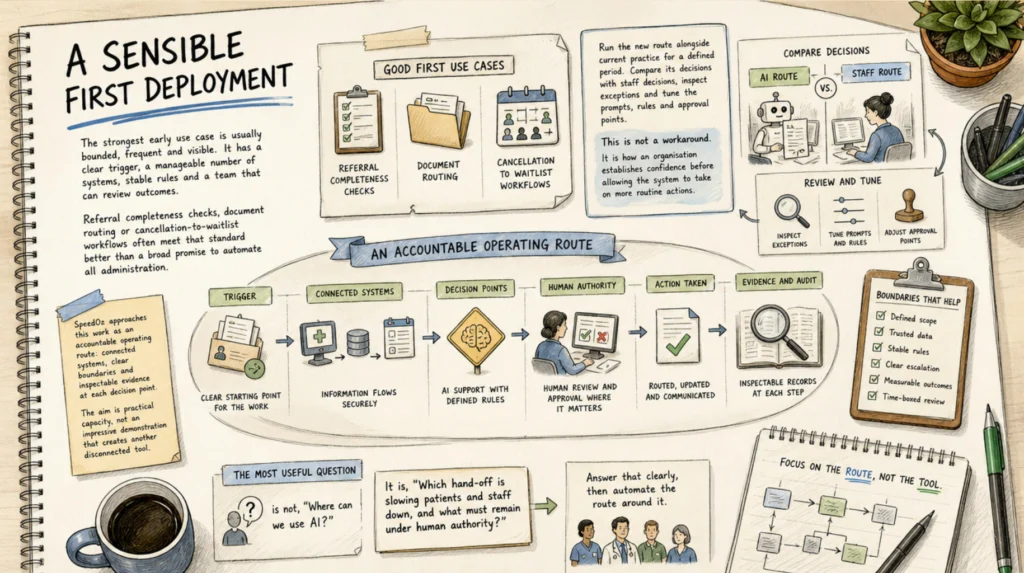
The strongest early use case is usually bounded, frequent and visible. It has a clear trigger, a manageable number of systems, stable rules and a team that can review outcomes. Referral completeness checks, document routing or cancellation-to-waitlist workflows often meet that standard better than a broad promise to automate all administration.
Run the new route alongside current practice for a defined period. Compare its decisions with staff decisions, inspect exceptions and tune the prompts, rules and approval points. This is not a workaround. It is how an organisation establishes confidence before allowing the system to take on more routine actions.
SpeedOz approaches this work as an accountable operating route: connected systems, clear boundaries and inspectable evidence at each decision point. The aim is practical capacity, not an impressive demonstration that creates another disconnected tool.
The most useful question is not, “Where can we use AI?” It is, “Which hand-off is slowing patients and staff down, and what must remain under human authority?” Answer that clearly, then automate the route around it.