

A service coordinator receives a customer request, searches three systems for history, checks technician availability, emails a quote for approval, then updates the job board. None of those steps is especially difficult. Together, they consume attention, delay response times and make errors hard to trace. An AI readiness assessment identifies whether this workflow is suitable for AI-enabled orchestration – and, just as importantly, where the system must stop for a person to decide.
For most Australian organisations, readiness is not about whether staff can write prompts or whether a chatbot can answer general questions. It is about operational fit. Can the right context be retrieved? Are the rules clear? Who has authority to approve an exception? Can the result be recorded as evidence? If the answer is unclear, deploying AI will simply automate uncertainty at greater speed.
What an AI readiness assessment should test
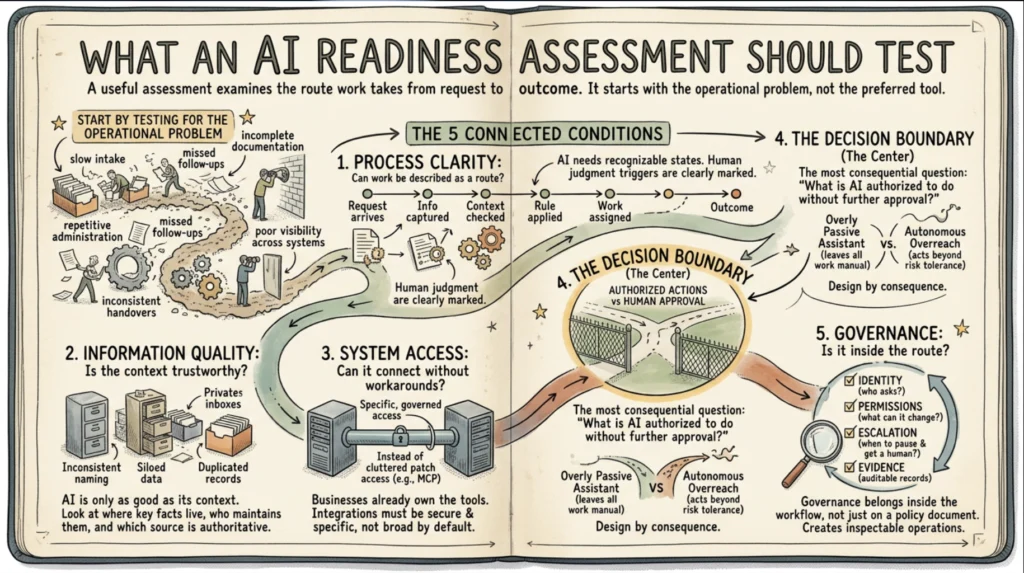
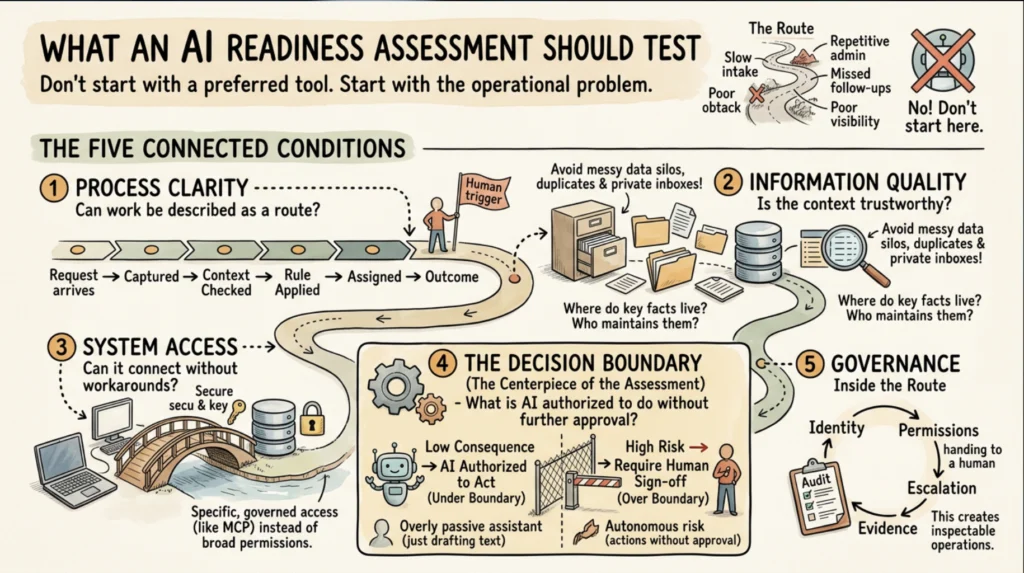
A useful assessment examines the route work takes from request to outcome. It does not begin with a preferred tool. It begins with the operational problem: slow intake, repetitive administration, missed follow-ups, incomplete documentation, inconsistent handovers or poor visibility across systems.
The assessment then tests five connected conditions: process clarity, information quality, system access, decision boundaries and governance. Weakness in one area does not mean AI is off the table. It changes the implementation sequence. A team with a valuable but undocumented process may first need workflow mapping. A business with reliable rules but fragmented data may need integration before an agent can act safely.
This is why a readiness assessment is not a pass-or-fail scorecard. It is a practical design exercise that separates opportunities ready for implementation from opportunities that require preparation.
Process clarity: can work be described as a route?
AI performs best when a workflow has recognisable states. A request arrives. Information is captured. Context is checked. A rule is applied. Work is assigned. An outcome is recorded. Human judgement can sit within that route, but it needs a clear trigger.
Consider a professional services firm preparing client onboarding packs. AI may extract details from submitted documents, check for missing information and create tasks for the right team. It should not independently accept a high-risk client, interpret unclear regulatory obligations or send final advice without a responsible professional’s review. The assessment identifies those boundaries before the workflow is built.
Process clarity does not require a perfect process map. It requires enough consistency to answer practical questions: what starts the work, what information is needed, what counts as complete, and what happens when the usual path breaks?
Information quality: is the context trustworthy?
AI agents are only as useful as the context supplied to them. If customer records are duplicated, job notes sit in private inboxes or documents use inconsistent naming, the system may produce a confident but incomplete action. That is a data and operating model problem, not a model problem.
An assessment should look at where key facts live, who maintains them and which source is authoritative. For a healthcare administration workflow, that may include referral details, appointment status, consent records and clinician instructions. For field service, it may include site history, asset details, service agreements, safety requirements and technician skills.
Not every source needs to be cleaned before work begins. The practical question is narrower: what minimum information must be accurate for this route to operate safely? Starting with a contained use case often produces a clearer data standard than attempting an organisation-wide clean-up with no defined outcome.
System access: can the workflow connect without workarounds?
Many businesses already own the applications needed to improve the workflow. The issue is that their CRM, ERP, inbox, service desk, document repository and internal tools do not share context at the point of work. Staff become the integration layer, copying information between screens and chasing updates.
Readiness means assessing available interfaces, permissions and event triggers. Can a new enquiry create a case? Can a case retrieve the relevant customer history? Can an approved action update the source system and notify the right person? Can the workflow read a document without exposing unrelated records?
Modern integration approaches, including Model Context Protocol server integrations, can give AI systems governed access to business tools. But access should be specific, not broad by default. An agent that can read a work order does not necessarily need permission to change pricing, issue a refund or delete a record.
The decision boundary is the centre of the assessment
The most consequential question in an AI readiness assessment is not, “What can AI do?” It is, “What is AI authorised to do without further approval?”
That distinction prevents two common failures. The first is an overly passive assistant that drafts useful text but leaves staff to complete every operational action manually. The second is an autonomous workflow that acts beyond the business’s risk tolerance because nobody defined a decision boundary.
A disciplined design classifies actions by consequence. Low-risk actions may be executed automatically: categorising an inbound request, retrieving a standard document, scheduling a routine follow-up or creating a task from approved information. Medium-risk actions may require approval: sending a tailored customer response, changing a booking, or assigning a job outside normal rules. High-risk actions should remain with an authorised person: approving clinical decisions, accepting contractual commitments, releasing sensitive information or making material financial changes.
The correct boundary depends on the business, the process and the cost of being wrong. A missed reminder can be corrected. A wrong diagnosis, payment instruction or compliance declaration carries a different standard. Readiness work makes that standard explicit.
What good governance looks like in practice
Governance is often treated as a policy document that appears after the system is live. In operational AI, it belongs inside the route.
For each workflow, define identity, permissions, escalation and evidence. Identity establishes whether the request is from a staff member, customer or trusted system. Permissions determine what the agent can retrieve or change. Escalation defines the conditions that pause the route and send it to a person. Evidence records the source context, decision path, approval and action taken.
This creates inspectable operations. If a manager asks why a customer received a certain response, the organisation should be able to see which information was used, which policy was applied, whether a human approved it and what changed in the source system. That is more useful than relying on a generic assurance that the AI behaved correctly.
Privacy and security need the same practical treatment. Sensitive information should be minimised, access should follow roles, and logs should be sufficient for review without creating a second uncontrolled store of confidential data. Requirements vary by sector, particularly in healthcare and regulated professional services, so the assessment must reflect actual obligations rather than generic claims of compliance.
Ready to get started?
A one-line nudge that earns the click below.
From assessment to a workable first route
The strongest first implementation is rarely the flashiest. It is a workflow with clear volume, a measurable delay or cost, available source data and a manageable exception rate. It should also have an accountable operational owner, not merely technical sponsorship.
A good sequence is to capture the request, connect relevant context, check policy, obtain approval where needed, coordinate the next action and record the outcome. Once this route is reliable, the business can extend it to adjacent work. For example, an AI-enabled field service intake process may first classify requests and prepare job information. Later, it can support triage, parts checks, customer updates and post-job documentation.
Measure results in operational terms. Track response time, rework, handling time, follow-up completion, backlog age, exception rate and capacity released for higher-value work. Cost savings matter, but they are not the only value. Better records, fewer missed handovers and faster service often improve revenue protection and customer trust as well.
SpeedOz approaches this work as system design, not chatbot deployment. The objective is connected action with clear authority: useful automation where rules are stable, human approval where judgement matters, and evidence at each consequential step.
The right first question is not whether your business is ready for AI in the abstract. Choose one work route where delay, duplication or weak visibility is costing your team time. Trace it carefully. The practical path forward usually becomes visible there.