

A purchase request sits in an inbox for three days because the right manager was travelling. A client proposal is approved in a chat thread, but nobody updates the CRM. A field technician needs an exception authorised before work can proceed, yet the supporting documents are split between a service platform, email and a shared drive.
These are not simply approval delays. They are routing failures. To automate approval routing properly, an organisation needs more than a form that sends emails to managers. It needs a controlled operating route: the system captures the request, understands its context, applies policy, directs it to the accountable person and records what happened.
The objective is not to remove people from consequential decisions. It is to remove the avoidable administration around those decisions while making authority clearer.
Why approval routing breaks as a business grows
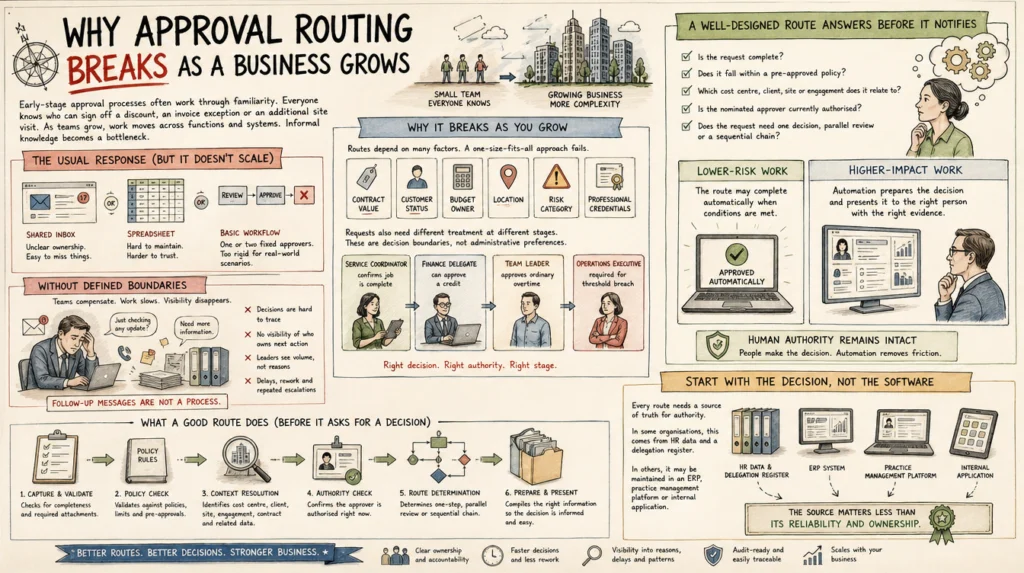
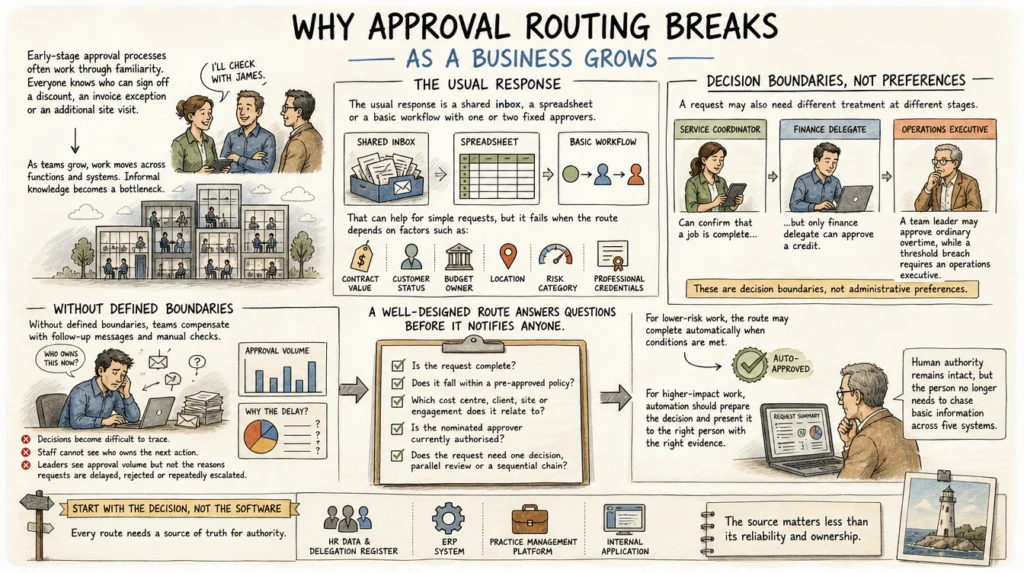
Early-stage approval processes often work through familiarity. Everyone knows who can sign off a discount, an invoice exception or an additional site visit. As teams grow, work moves across functions and systems. Informal knowledge becomes a bottleneck.
The usual response is a shared inbox, a spreadsheet or a basic workflow with one or two fixed approvers. That can help for simple requests, but it fails when the route depends on factors such as contract value, customer status, budget owner, location, risk category or professional credentials.
A request may also need different treatment at different stages. A service coordinator can confirm that a job is complete, but only a finance delegate can approve a credit. A team leader may approve ordinary overtime, while a threshold breach requires an operations executive. These are decision boundaries, not administrative preferences.
Without defined boundaries, teams compensate with follow-up messages and manual checks. Decisions become difficult to trace. Staff cannot see who owns the next action. Leaders see approval volume but not the reasons requests are delayed, rejected or repeatedly escalated.
What it means to automate approval routing
Approval automation is often described as moving a request from point A to point B. In practice, effective routing has six connected parts: capture the request, assemble relevant context, check policy, identify the correct authority, manage the decision and record evidence.
The distinction matters. Sending every request to a manager may be automated, but it is not intelligent routing. It creates a new queue rather than resolving the operating problem.
A well-designed route answers practical questions before it notifies anyone. Is the request complete? Does it fall within a pre-approved policy? Which cost centre, client, site or engagement does it relate to? Is the nominated approver currently authorised? Does the request need one decision, parallel review or a sequential chain?
For lower-risk work, the route may complete automatically when conditions are met. For higher-impact work, automation should prepare the decision and present it to the right person with the right evidence. Human authority remains intact, but the person no longer needs to chase basic information across five systems.
Start with the decision, not the software
The fastest way to create a fragile workflow is to start with a platform feature and force the process into it. Begin with one approval type and map how it should operate.
Take a variation approval for a field service job. The request may begin when a technician uploads photos and notes from a mobile device. The system can identify the job, customer, work order, quoted amount and technician. It can then compare the variation amount against contract rules and delegated authority limits.
If the value is within a site manager’s authority, the route goes to that manager. If it exceeds the threshold, it may require both commercial review and customer confirmation. If mandatory photos or scope notes are missing, it returns to the technician before an approver is involved.
This mapping exposes ambiguity that software cannot solve by itself. Who owns an expired request? Can a delegate approve while the usual manager is on leave? What happens when the requester and approver are the same person? Can an approval be reversed after downstream work begins?
These questions are where governance becomes operational. They should be settled before implementation, not discovered after an exception causes a dispute.
Define authority and exceptions explicitly
Every route needs a source of truth for authority. In some organisations, this comes from HR data and a delegation register. In others, it may be maintained in an ERP, practice management platform or internal application. The source matters less than its reliability and ownership.
Avoid embedding approval names directly into workflow logic wherever possible. People change roles, take leave and move between business units. Routes should use roles, limits and current organisational data, then resolve the appropriate person at the point of decision.
Exceptions deserve their own route. A policy breach should not disappear into the same queue as routine work. It may need a different approver, added evidence, a time limit or an explicit risk acceptance. Treating exceptions visibly protects both the requester and the decision-maker.
Connect context before asking for approval
Approvers make weaker decisions when each request arrives as a thin email asking them to reply with “yes”. The route should assemble the information required to decide without turning every approval into an investigation.
For a professional services firm, that may include the client record, engagement terms, work-in-progress, budget position and proposed write-off. In healthcare administration, it may include referral details, consent status, appointment history and the appropriate access controls. In field service, it may include asset history, safety documentation, job margin and customer commitments.
This is where orchestration matters. A workflow can connect CRM, ERP, service desk, document repository and inbox data, then present a concise approval brief. An AI component may classify an incoming request, extract details from documents or flag a missing item. It should not silently invent a decision or override a policy.
Where AI is used, define its role narrowly. It can recommend a route, summarise evidence or identify anomalies. A deterministic policy layer should still govern material thresholds, permissions and mandatory checks. For consequential decisions, the accountable person should be able to inspect the source information and reasoning behind the recommendation.
Build controls into the route
A route that is quick but untraceable creates a different kind of operational risk. Approval automation needs controls that fit the work rather than bury teams in friction.
At a minimum, record who submitted the request, the information available at the time, the policy checks performed, the people asked to approve, their decision, any comments and the downstream actions triggered. This evidence is valuable for audit, but it is also useful for everyday management. It explains why work moved, stopped or changed direction.
Identity checks are equally important. Approval should be tied to an authenticated user and a defined authority, not merely an email address or a message reaction. Delegation rules should be explicit, time-bound and visible.
Escalation requires care. Automatically escalating every overdue item can produce noise and encourage rubber-stamping. Instead, set escalation based on operational impact. A same-day patient administration task, a customer-facing variation and a low-value internal purchase should not share the same service level.
Design the route for real operating conditions
The best approval process on a whiteboard can fail when it meets incomplete data, mobile workers and competing priorities. Build for those conditions from the beginning.
Requests should validate essential fields before they enter an approval queue. Approvers should receive a clear action request, not a system-generated message with an obscure reference number. If they need to choose between approve, reject and request changes, each action should trigger a known next step.
Consider what happens after approval too. A decision should update the relevant record, notify the right parties and create the next operational task. An approved discount may need to update a quote. An authorised variation may need to issue a work order and notify the customer. A rejected expense should return to the employee with a reason rather than simply closing the request.
Not every process needs a complex multi-agent system. A stable, low-volume approval with one clear owner may be better served by a simple route. Complexity is justified when the work crosses multiple systems, relies on changing context or carries enough financial, compliance or customer risk to warrant stronger controls.
Ready to get started?
A one-line nudge that earns the click below.
Measure capacity, not just turnaround time
Approval time is a useful measure, but it is not the only one. A route can be fast because people approve without sufficient review. Equally, a longer route may be appropriate for a higher-risk decision.
Track the measures that reveal whether the process is improving operations: requests received, first-pass completeness, approval cycle time by route, rework rate, exception volume, escalation rate and downstream errors. Review which policies create repeated exceptions. That may signal a training issue, an outdated delegation limit or a process that no longer matches commercial reality.
This is also where implementation teams can find tangible capacity. If coordinators spend hours each week gathering information, chasing approvers and re-entering decisions across systems, the value is not only speed. It is the return of skilled attention to customer work, quality and exception handling.
SpeedOz approaches this as an accountable operating route, not a chatbot added to a broken process. The route needs connected systems, clear boundaries and inspectable evidence at each material decision point.
A practical first route to automate
Choose a process with enough volume to matter and enough consistency to define. Expense exceptions, purchase requests, quote discounts, service variations and document approvals are common starting points. Avoid beginning with the most politically complex process in the business, even if it is painful.
Map the current path using real examples. Identify the trigger, required information, policy rules, decision-maker, exception path, system updates and evidence to retain. Then test the proposed route against awkward cases: a missing document, a manager on leave, a request above threshold, a duplicate submission and a rejected decision that must return for correction.
A controlled first implementation creates a pattern that can be reused. Over time, approval routing becomes less about chasing permission and more about directing accountable decisions through the business with the context to make them well. That is the point where automation begins to create operational confidence, not just faster notifications.