
A service coordinator asks an AI assistant to reschedule a technician, notify the customer and update the job record. That request crosses calendars, field-service software, customer data and potentially pricing rules. The real question in MCP versus API integrations is not which technology is newer. It is how the work is authorised, coordinated and recorded when an AI system begins acting across business systems.
APIs remain essential. They are the dependable connections that let software exchange data and perform defined actions. Model Context Protocol, or MCP, addresses a different operational problem: how an AI agent discovers and uses approved tools and context without every interaction being hard-coded into a one-off integration.
For Australian organisations moving beyond chatbot trials, that distinction matters. A useful system must do more than produce a convincing answer. It must know what it is allowed to see, what it can change, when it needs approval and how to leave evidence behind.
MCP versus API integrations: the practical distinction
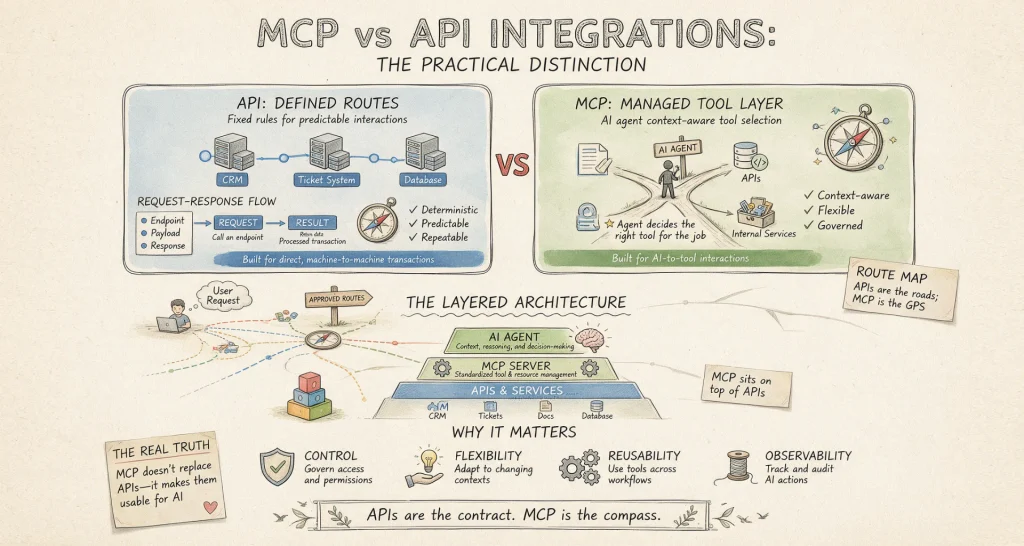
An API is a formal interface between applications. A developer can instruct a workflow to call an endpoint, retrieve a customer record, create a ticket or change a job status. The request follows known rules: use this system, send these fields, receive this response. It is direct, predictable and well suited to repeatable transactions.
MCP is a protocol designed to give AI models a controlled way to work with external tools, resources and prompts. An MCP server can expose selected capabilities from a CRM, document store, service desk or internal application. The AI agent can then use those capabilities within the permissions and instructions set by the organisation.
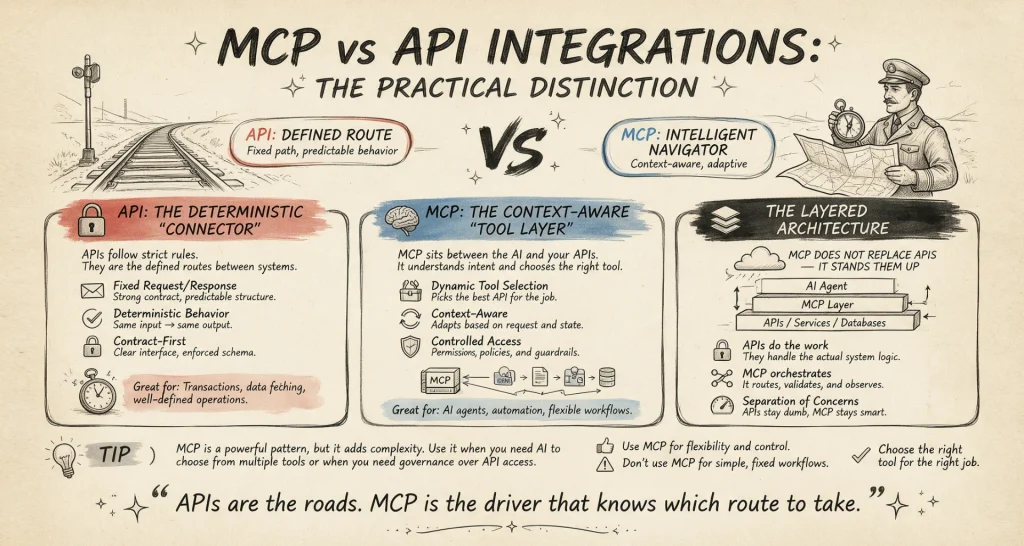
The important correction is that MCP does not replace APIs. In many cases, an MCP server sits over existing APIs, databases or internal services. The API does the system-level work. MCP provides a standard operating surface for the AI agent.
Think of an API as a defined route between two systems. MCP is a managed tool layer that lets an AI agent assess which approved route is relevant to a request. One is often deterministic by design. The other introduces contextual selection, which creates both useful flexibility and a greater need for control.
Where direct API integrations remain the right choice
Not every process needs an AI agent. If a workflow is stable, high volume and unambiguous, a conventional API integration is usually the better engineering choice.
A nightly ERP-to-finance synchronisation is a clear example. So is sending a completed web form into a CRM, generating an invoice after an approved milestone, or updating stock levels when a purchase order is received. These processes benefit from fixed triggers, defined fields, retries and exception handling. The workflow should not need a model to interpret intent.
Direct API integrations also make sense where latency, transaction integrity or strict process determinism are paramount. A payment submission, a clinical system update or a payroll change should follow tightly controlled routes. AI may help prepare or classify the work, but it should not be free to decide the final system action.
This does not make APIs less strategic. It makes them foundational. They provide the reliable operational connections on which controlled AI orchestration depends.
Where MCP creates operational value
MCP becomes useful when work begins with human language, scattered context and a choice of next actions. These are common conditions in service operations, healthcare administration and professional services.
Consider a client email asking why a project milestone has slipped. A capable AI assistant may need to read the email, identify the client and project, inspect current tasks, check resourcing notes, draft a response and create a follow-up for the project lead. Hard-coding every possible sequence becomes difficult because the request and its context vary each time.
With MCP, the assistant can be given access to a curated set of tools: search client records, retrieve approved project information, create a draft follow-up and prepare a response. It does not need unrestricted access to every system function. The organisation can define the available tools, their input requirements and the situations where a person must approve the action.
The value is not that the agent has more freedom. The value is that it can work across approved systems without turning every new operational question into a bespoke integration project.
Ready to get started?
A one-line nudge that earns the click below.
The control problem is the real design problem
An AI agent that can read and write across systems changes the risk profile. A poorly governed connection can expose confidential material, create inaccurate records or allow an agent to take an action that should have remained with a person.
MCP does not solve governance automatically. It gives teams a useful structure for implementing it. The discipline comes from the operating design around the protocol.
For consequential workflows, define the route before building the tools. A sound route usually follows five stages:
- Capture the request and identify the user, customer or case involved.
- Retrieve only the context needed for the task from approved sources.
- Check policy, permissions, data sensitivity and confidence conditions.
- Obtain human approval before commitments, financial changes, clinical decisions or external representations.
- Execute the permitted action and record the input, decision, approval and outcome.
The fifth stage is often neglected. If a department cannot explain why an action occurred, who approved it and which information informed it, the workflow is difficult to improve and risky to scale. Evidence is not an administrative extra. It is part of operational control.
Designing MCP servers with boundaries
The quality of an MCP implementation is determined less by the protocol than by the tools it exposes. A broad tool called “manage customer” is a poor boundary. It encourages vague requests and makes permissions difficult to reason about.
Smaller, purpose-built tools are easier to govern. “Retrieve customer contact details”, “create a draft service case” and “submit an approved appointment change” express distinct actions with distinct permissions. They also make logs more meaningful.
Read access and write access should be separated wherever possible. An agent may be permitted to assemble a briefing from a CRM, job system and document repository, while only a team leader can approve the creation of a credit note or a change to a customer commitment. The approval should occur at the decision boundary, not after the system has already acted.
Context boundaries matter just as much. An AI assistant should not receive an entire document repository because a user asks a broad question. Retrieve relevant material, apply role-based access and avoid passing sensitive fields where they are not required. This is especially relevant for healthcare administrators handling patient-adjacent information and professional firms managing confidential client files.
Choosing the architecture for the work
The useful question is rarely “MCP or API?” It is “which parts of this route need deterministic automation, and which parts need contextual AI assistance?” Most mature designs use both.
A field-service business might use APIs to synchronise jobs, technician availability and customer records on fixed schedules. An MCP-enabled concierge agent can then handle an inbound request such as, “Can someone attend this afternoon, and will the original quote still apply?” The agent gathers context, checks service rules and prepares options. If a price exception is needed, it sends the decision to an authorised person rather than improvising a promise.
A professional services firm may use direct integrations to create matters, store time entries and issue approved invoices. MCP can support the less structured work around those transactions: preparing a matter brief, finding precedent material within permissions, or drafting a client update for review.
The same principle applies to multi-agent systems. Splitting work between specialist agents can improve capacity, but only when responsibilities are clear. One agent may classify incoming work, another may retrieve context, and a third may prepare a recommendation. None should be allowed to quietly expand its authority simply because it can call a tool.
Questions to settle before implementation
Before connecting an AI agent to operational systems, leaders should be able to answer a few practical questions. What outcome is the workflow meant to improve: response time, administrative capacity, conversion, compliance or service quality? Which source system remains the record of truth? What actions can the agent prepare, and what actions can it execute?
They should also identify the failure route. If information is missing, policy is unclear or the model has low confidence, where does the work go? A useful AI system escalates cleanly. It does not fill gaps with plausible language and present that as certainty.
Finally, measure the route as it operates. Track time saved, hand-offs removed, approvals required, exception rates and rework. Those measures show whether the system is adding capacity without moving hidden risk into another team.
SpeedOz approaches this work as an operating route, not a chatbot deployment. Existing APIs, internal applications and MCP servers can work together when identity, policy checks, approvals and inspectable evidence are designed into the flow from the start.
The best first use case is usually narrow but meaningful: a high-frequency request with clear inputs, known systems and a visible approval point. Build that route carefully, observe where people intervene, then extend authority only where the evidence supports it.