A standalone AI tool can produce an impressive result in minutes. It can draft a response, summarise a document or classify an enquiry. But if that result must then be copied into a CRM, checked against policy, approved by a manager and handed to another team, the work has not truly moved. That is the practical difference in AI orchestration versus point solutions: one improves an individual task; the other governs how work travels across the business.
For Australian organisations already carrying a mix of CRMs, service desks, inboxes, document stores, ERP platforms and internal tools, this distinction matters. The question is not whether an AI product has useful features. It is whether it can contribute to an accountable operating route.
What point solutions do well
A point solution applies AI to a defined job. It may transcribe calls, generate meeting notes, answer common customer questions, extract information from forms or help a team write proposals faster. These tools can create immediate value, particularly where the work is contained, low risk and repeated often.
A field service business, for example, might use AI to convert a technician’s voice note into a job summary. A professional services firm might use it to prepare a first draft of a client update. A healthcare administration team might use it to categorise incoming referral documents before a coordinator reviews them.
Used with care, these are worthwhile improvements. They reduce friction at the edge of a process and give teams a faster starting point. A point solution is often the right place to test a use case because the scope is clear and the consequences are limited.
The weakness appears when the task sits inside a larger operational flow. An AI-generated job summary does not by itself update the service record, identify a missing compliance document, request customer confirmation, route an exception to the right supervisor or leave evidence of who approved a change. Staff still become the integration layer. They shift information between screens, interpret incomplete context and carry the risk when something is missed.
AI orchestration versus point solutions: the operational difference
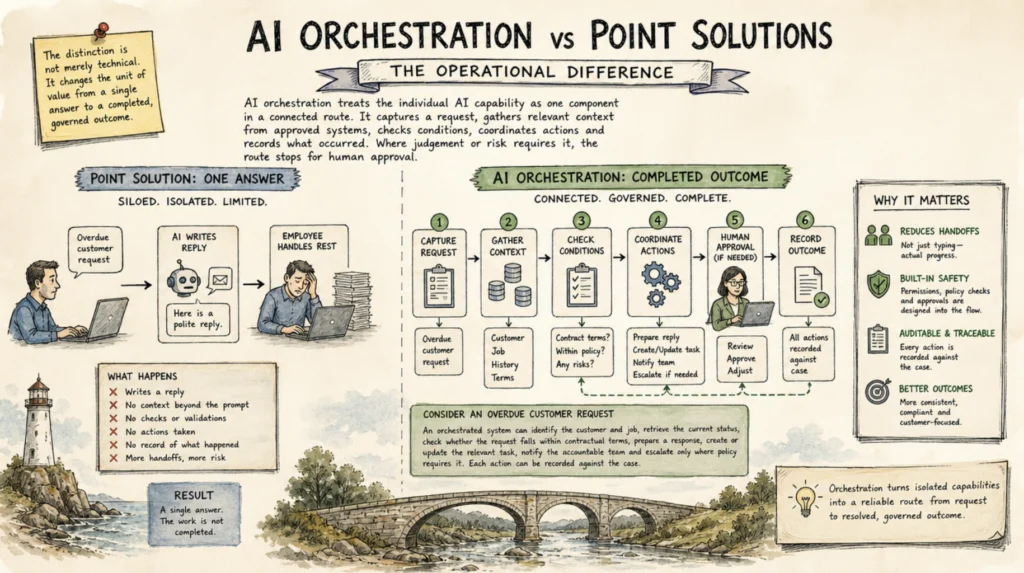
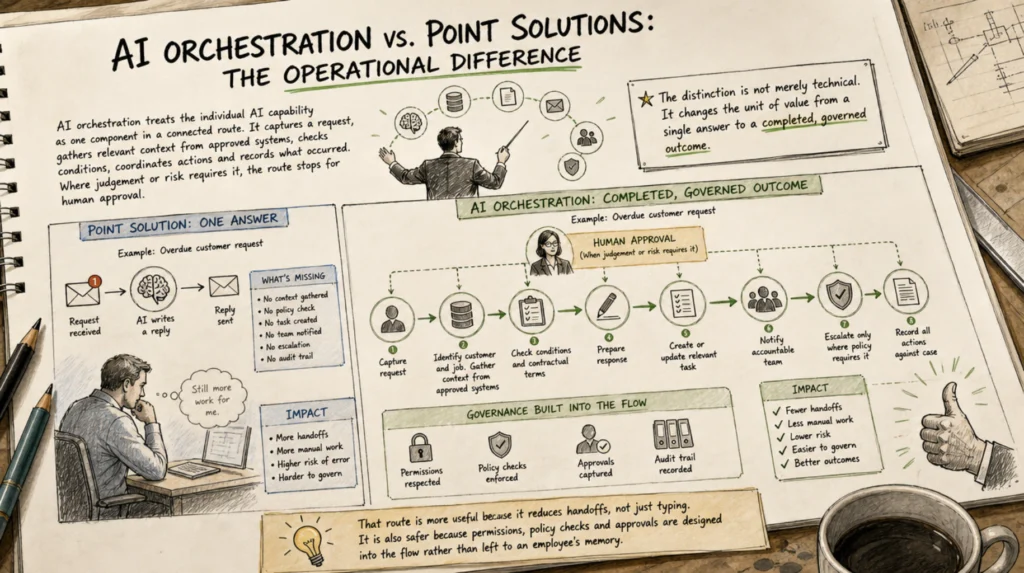
AI orchestration treats the individual AI capability as one component in a connected route. It captures a request, gathers relevant context from approved systems, checks conditions, coordinates actions and records what occurred. Where judgement or risk requires it, the route stops for human approval.
The distinction is not merely technical. It changes the unit of value from a single answer to a completed, governed outcome.
Consider an overdue customer request. A point solution might write a polite reply. An orchestrated system can identify the customer and job, retrieve the current status, check whether the request falls within contractual terms, prepare a response, create or update the relevant task, notify the accountable team and escalate only where policy requires it. Each action can be recorded against the case.
That route is more useful because it reduces handoffs, not just typing. It is also safer because permissions, policy checks and approvals are designed into the flow rather than left to an employee’s memory.
Context must be connected, not guessed
AI is only as reliable as the context available at the moment of action. A point tool often operates on the text placed in front of it. This is suitable for simple drafting and summarisation. It is less suitable when an answer depends on current customer status, work history, inventory, entitlements, financial limits or confidential records.
Orchestration connects approved sources of truth. This may involve APIs, workflow automation, internal applications and Model Context Protocol integrations that allow agents to retrieve defined information or take permitted actions. The aim is not to expose every system to an AI model. It is to provide the minimum context and tools required for the route.
That boundary matters. A scheduling agent may need to read technician availability and create a draft booking. It may not need authority to alter pricing, approve overtime or access unrelated client files. Good orchestration makes such distinctions explicit.
Decisions need boundaries
Not every operational decision deserves the same treatment. Some actions can be automated when rules are clear and the downside is low. Others should be proposed by AI but approved by a person. A smaller group should remain entirely human-led.
This is where many fragmented AI deployments lose credibility. A chatbot may be able to recommend an action, but there is no clear answer to who owns the final decision, what policy was applied or what happens when information conflicts.
An orchestrated route defines these boundaries before deployment. It specifies the trigger, the systems that may be accessed, the checks to apply, the actions that can proceed automatically and the approval required for exceptions. For a healthcare administration workflow, AI may extract referral details and identify missing fields, while a qualified staff member confirms triage and clinical relevance. For a professional services workflow, AI may assemble matter information and draft correspondence, while the responsible practitioner authorises advice.
Human authority is not a concession to older ways of working. It is a design feature for consequential work.
The hidden cost of a growing AI tool stack
Point solutions commonly multiply because each department can justify a local purchase. Sales adopts one assistant, customer service another, operations a third and finance a separate document tool. Each may save time within its own screen. Across the organisation, however, the result can be duplicated data, inconsistent customer communication, unclear permissions and a growing number of unmanaged subscriptions.
The cost is not only licence spend. It is the operational overhead of deciding where the latest information sits, training staff on different interfaces, maintaining separate security reviews and resolving the gaps between tools. When a process crosses departments, people often return to email and spreadsheets because the AI products do not share context or accountability.
Orchestration does not require replacing every existing platform. In fact, the stronger approach usually respects systems that already hold business value. The CRM remains the customer record. The ERP remains the financial record. The service desk remains the work record. AI coordinates approved actions between them.
This makes investment easier to evaluate. Rather than asking whether an assistant is clever, leaders can measure whether a route reduces response time, removes manual touches, increases jobs completed per coordinator or improves the quality of recorded evidence.
When a point solution is the better choice
Orchestration is not automatically the answer to every AI opportunity. Building a connected route requires process mapping, access design, testing and change management. If a task is genuinely isolated, infrequent or experimental, a point solution may deliver better value with less effort.
A sensible test is to ask four questions:
- Does the task require information from more than one system?
- Does it trigger an action outside the tool where it begins?
- Could an error create customer, financial, compliance or safety consequences?
- Is a person currently spending time moving context between systems?
If the answer is yes to several of these, the use case is likely an orchestration candidate. If the task is simply creating a first draft that a person will use independently, a point solution may be enough.
The goal is not to turn every workflow into a multi-agent system. It is to apply the right level of design to the level of operational consequence.
Ready to get started?
A one-line nudge that earns the click below.
How to move from tools to accountable routes
Start with a real workflow, not a preferred product. Choose a process with visible volume, repeated handoffs and a measurable delay or error rate. Map what enters the process, who touches it, which systems hold the required context and where decisions are currently made.
Then separate actions by authority. Identify what AI can prepare, what it can execute under clear rules and what requires review. Define the evidence that should be captured at each decision boundary. This could include the source data used, the policy check completed, the approver’s identity and the final outcome.
Only then should the technology design follow. The right architecture may include a single agent, workflow automation and a few system integrations. A more complex route may require specialised agents with distinct permissions, coordinated through shared rules and human approval gates. Complexity should serve the workflow, not the other way around.
SpeedOz approaches AI implementation in this order: map the work, connect the relevant context, define boundaries, build the route and measure the result. The practical outcome is capacity that can be inspected and governed, rather than another isolated tool for staff to manage.
The most valuable AI systems do not merely generate good outputs. They help the right work move forward with the right context, the right authority and a clear record of why each action occurred.