

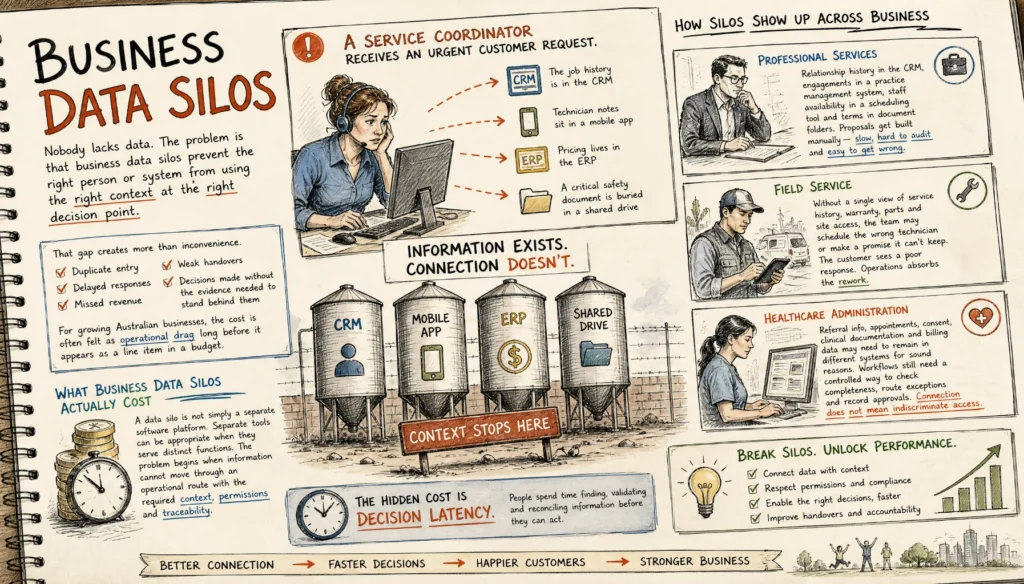
A service coordinator receives an urgent customer request. The job history is in the CRM, technician notes sit in a mobile app, pricing lives in the ERP, and a critical safety document is buried in a shared drive. Nobody lacks data. The problem is that business data silos prevent the right person or system from using the right context at the right decision point.
That gap creates more than inconvenience. It creates duplicate entry, delayed responses, missed revenue, weak handovers and decisions made without the evidence needed to stand behind them. For growing Australian businesses, the cost is often felt as operational drag long before it appears as a line item in a budget.
What business data silos actually cost
A data silo is not simply a separate software platform. Separate tools can be appropriate when they serve distinct functions. The problem begins when information cannot move through an operational route with the required context, permissions and traceability.
Consider a professional services firm preparing a client proposal. The relationship history may be held in the CRM, prior engagements in a practice management system, staff availability in a scheduling tool and commercial terms in document folders. A partner can still assemble the proposal manually, but that work depends on memory, inbox searches and informal messages. The process is slow, difficult to audit and vulnerable to omission.
In field service, the same pattern appears when a customer calls about an asset fault. If the dispatcher cannot see service history, warranty status, parts availability and site access requirements together, the team may schedule the wrong technician or make a promise it cannot keep. The customer sees a poor response. Operations absorbs the rework.
Healthcare administration raises the stakes further. Referral information, appointment records, consent, clinical documentation and billing data may need to remain in different systems for sound reasons. Yet the administrative workflow still needs a controlled way to check completeness, request missing information, route exceptions and record approvals. Connection does not mean indiscriminate access.
The hidden cost is decision latency. People spend time finding, validating and reconciling information before they can act. When that becomes normal, experienced staff become the integration layer. They carry institutional knowledge in their heads and inboxes. Capacity becomes tied to individual availability rather than a dependable operating process.
Why integration alone does not remove silos
Many businesses respond by connecting applications. That is often necessary, but a point-to-point integration does not automatically create a reliable workflow. It can simply move incomplete, outdated or unauthorised information faster.
A useful design question is not, “Can these systems exchange data?” It is, “What action should occur when this event happens, who may authorise it, and what evidence must be retained?” This shifts the work from technical connection to operational orchestration.
For example, an inbound request could trigger a search across the CRM and service platform. That is a basic connection. A governed operational route goes further: it identifies the customer, checks entitlement or contract status, gathers relevant history, applies policy rules, routes a pricing exception to an authorised manager, creates the approved job and records the outcome against the relevant systems.
Each step has a purpose. Context reduces manual searching. Policy checks prevent unsuitable action. Human approval protects consequential decisions. Recorded evidence makes the route inspectable after the fact.
There are trade-offs. A fully automated route may be appropriate for a low-value, repeatable request with stable rules. It is less appropriate where safety, contractual exposure, clinical administration or professional judgement is involved. The right level of automation depends on risk, variability and the cost of an incorrect decision.
Designing a route across disconnected systems
The strongest response to data silos starts with a real workflow, not a technology shopping list. Map the work that currently crosses teams and systems. Follow it from trigger to outcome, including the exceptions that staff manage outside the documented process.
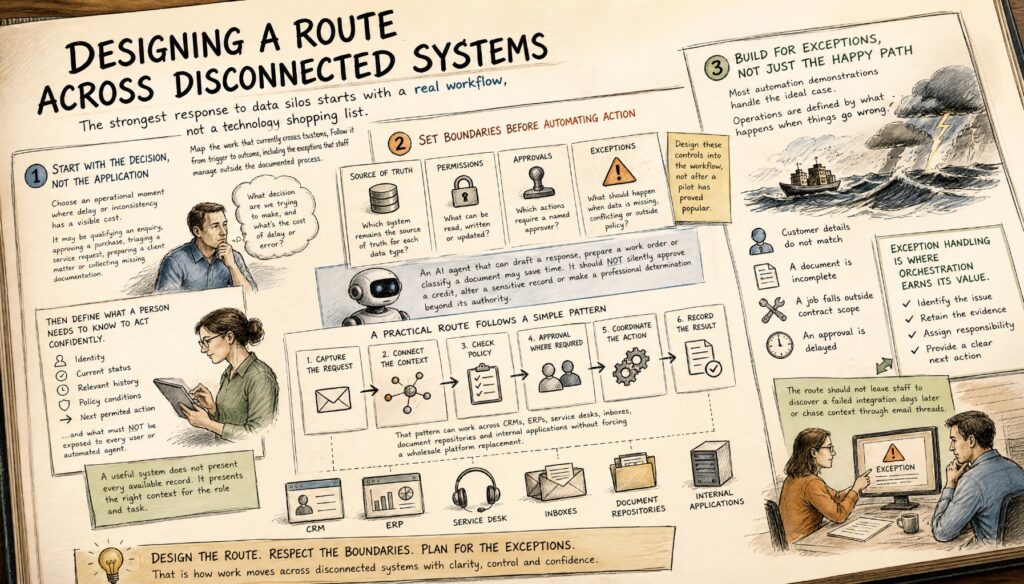
Start with the decision, not the application
Choose an operational moment where delay or inconsistency has a visible cost. It may be qualifying an enquiry, approving a purchase, triaging a service request, preparing a client matter or collecting missing documentation.
Then define what a person needs to know to act confidently. This usually includes identity, current status, relevant history, policy conditions and the next permitted action. It may also include information that must not be exposed to every user or automated agent.
This distinction matters. A useful system does not present every available record. It presents the right context for the role and task.
Set boundaries before automating action
Once the route is clear, define the boundaries. Which system remains the source of truth for each data type? What can be read, written or updated? Which actions require a named approver? What should happen when data is missing, conflicting or outside policy?
These controls should be designed into the workflow, not added after a pilot has proved popular. An AI agent that can draft a response, prepare a work order or classify a document may save time. It should not silently approve a credit, alter a sensitive record or make a professional determination beyond its authority.
A practical route often follows a simple pattern: capture the request, connect the relevant context, check policy, obtain approval where required, coordinate the action and record the result. That pattern can work across CRMs, ERPs, service desks, inboxes, document repositories and internal applications without forcing a wholesale platform replacement.
Build for exceptions, not just the happy path
Most automation demonstrations handle the ideal case. Operations are defined by what happens when customer details do not match, a document is incomplete, a job falls outside contract scope or an approval is delayed.
Exception handling is where orchestration earns its value. The route should identify the issue, retain the evidence, assign responsibility and provide a clear next action. It should not leave staff to discover a failed integration days later or chase context through email threads.
Use AI where judgement needs support, not surrender
AI can help reduce the manual effort caused by fragmented information. It can classify inbound requests, extract data from documents, summarise a customer history, identify missing fields and prepare a draft response using approved business context.
Its role should be bounded. AI is effective when it assists people with retrieval, interpretation and preparation inside a controlled route. It is less reliable when asked to operate as an unaccountable decision-maker with broad access to business systems.
Modern integration approaches, including Model Context Protocol server connections and multi-agent systems, can give AI access to the tools and data it needs for a defined task. The design still needs permissions, identity checks, audit records and human authority at consequential decision points. Connected action is valuable only when the organisation can explain how it occurred.
For leaders, the test is straightforward: can you see what information informed the action, which rule or approval applied, and what changed in each system? If not, the workflow may be faster, but it is not yet governed.
Ready to get started?
A one-line nudge that earns the click below.
Measure capacity, not just integration activity
A project is not successful because several applications are connected. Measure whether the route reduces the work that was previously required to move information between people and systems.
Useful measures include response time, first-time completion, approval turnaround, rework volume, exception rates and the proportion of requests resolved without manual searching. In regulated or high-accountability environments, also measure evidence completeness and the number of decisions made with a documented approval trail.
Start with one route that is frequent enough to matter and contained enough to govern well. Prove the operational change, then extend the model to adjacent workflows. SpeedOz approaches this as an accountable operating route: connected systems, clear boundaries and evidence at each meaningful handover.
The aim is not to eliminate every separate platform. It is to ensure that when work needs to move, context moves with it, authority remains clear and people can spend their judgement where it has the greatest value.