

A service coordinator receives a job request by email, checks customer history in the CRM, opens the scheduling platform, confirms stock in the ERP, asks a manager for approval, then updates three systems. None of those steps is especially difficult. Together, they create delay, rework and weak visibility. AI strategy consulting Australia should begin with this kind of operational reality, not a generic chatbot demonstration.
The useful question is not, “Where can we add AI?” It is, “Where does work slow down, who owns the decision, what information is required, and what evidence must remain after action is taken?” That shifts AI from an experiment into an accountable operating route.
What AI strategy consulting in Australia should deliver
A sound AI strategy is a plan for changing how work moves through the business. It identifies high-value workflows, connects the systems involved, defines authority at each decision boundary and establishes how performance will be measured. The result may include AI agents, automation, machine learning or improved integrations. Those are delivery mechanisms, not the strategy itself.
For Australian organisations, this work commonly starts in environments with established technology but fragmented execution. A CRM holds customer context. An ERP contains commercial and stock data. The service desk records issues. Staff still copy information between tools, chase approvals in email and reconstruct what happened when a customer asks a question. The issue is rarely a lack of software. It is the absence of a governed route between systems and people.
A consulting engagement should therefore produce more than a use-case list. Leaders need a prioritised workflow portfolio, a clear target architecture, decision and permission rules, implementation sequencing, ownership and measurable capacity targets. If those outputs are missing, the business may have a promising prototype but not a reliable operational system.
Start with work, not the model
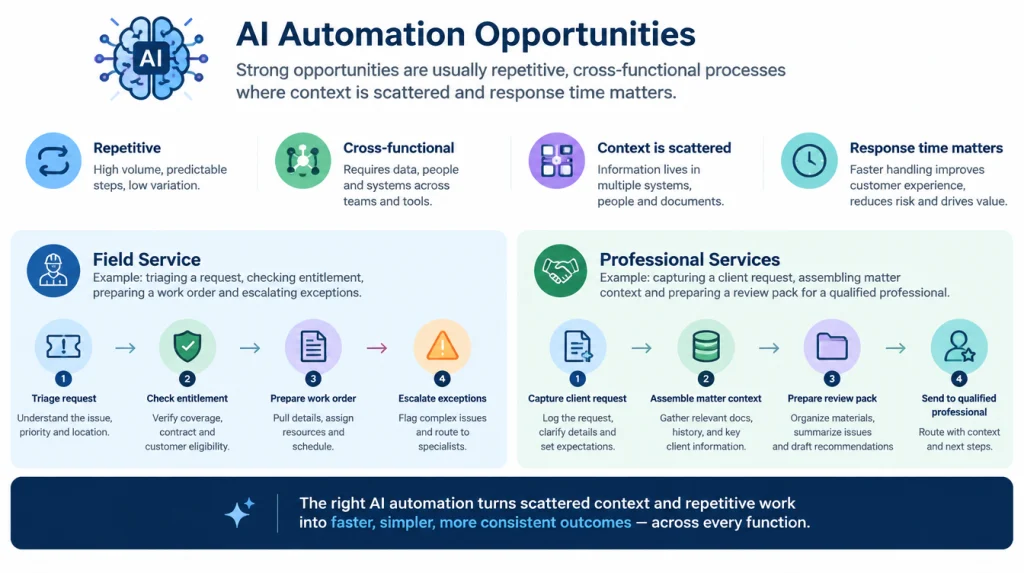
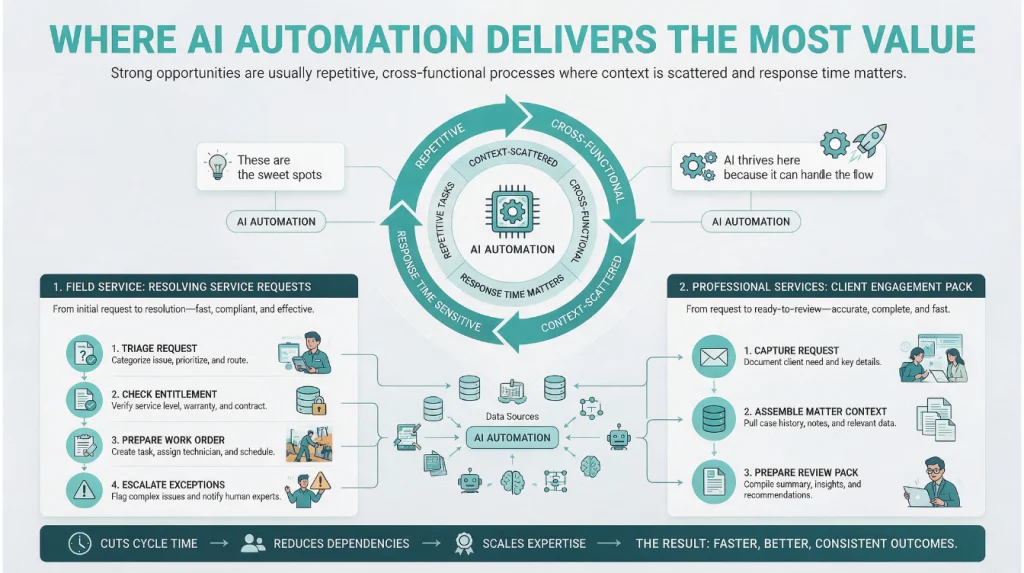
The strongest opportunities are usually repetitive, cross-functional processes where context is scattered and response time matters. In field service, that might be triaging a request, checking entitlement, preparing a work order and escalating exceptions. In healthcare administration, it may be collecting referral information, checking documentation completeness and routing work to the right team without making a clinical decision. In professional services, it could involve capturing a client request, assembling matter context and preparing a review pack for a qualified professional.
Each example has a different risk profile. That is why a strategy cannot treat every task as suitable for autonomous action. A system can prepare, classify, retrieve, draft and coordinate. A person should retain authority where judgement, legal responsibility, clinical implications, commercial exceptions or relationship risk are material.
The practical design principle is simple: automate the movement of work, not unexamined decisions.
Map the operating route
Workflow mapping exposes where AI can create value without creating confusion. The map should follow a request from entry to outcome: what triggers it, which data sources provide context, what policy applies, who can approve action, which systems are updated and what record must be retained.
This approach often reveals that the first improvement is not an AI model at all. It may be a clean intake form, a consistent customer identifier, a policy register or a better integration between two existing platforms. That is not a failure of the AI initiative. It is the work required to make automation dependable.
Once the route is clear, AI can perform bounded tasks with useful context. An agent may read an inbound request, identify missing information, retrieve relevant records and propose the next action. It should not silently issue a refund, alter a contractual commitment or close a sensitive case unless the approved policy explicitly permits it.
Ready to get started?
A one-line nudge that earns the click below.
Practical perspectives on AI orchestration, connected systems and keeping people in control.
Design boundaries before deploying agents
The term “agent” can obscure a basic operational requirement: every action needs a defined authority. An AI agent that can access email, customer data and business systems can be valuable. It can also create real exposure if permissions, escalation and logging are unclear.
Good strategy work establishes four controls early. Identity determines which user, service or agent is acting. Permissions specify what that actor can read, recommend or change. Approval rules identify where a person must authorise an action. Evidence records the context, policy check, decision and resulting update.
These controls should fit the level of consequence. An agent that drafts an internal meeting summary needs lighter oversight than one that changes job priority, sends customer commitments or processes payment-related information. The aim is not to place a human in every step. It is to place human authority where it protects customers, staff and the business.
This matters particularly in regulated or documentation-heavy environments. Healthcare administration teams need confidence that administrative automation does not overstep into clinical judgement. Professional services firms need traceable handling of client information and reviewable advice workflows. Field service businesses need dispatch and pricing rules that reflect real commercial authority rather than an agent’s best guess.
Connect context across the systems you already own
AI produces better work when it can use the right business context at the right moment. That context is usually distributed across existing applications, not sitting in a single knowledge base. The strategic task is to connect those sources without giving every tool unrestricted access to everything.
Model Context Protocol, often called MCP, is one approach for exposing approved tools and data sources to AI systems through controlled interfaces. In practical terms, it can let an agent retrieve a job record, check a policy or create a service ticket using defined actions rather than relying on copied data or broad database access.
MCP is not automatically the answer for every organisation. Direct integrations, APIs, workflow platforms and secure data services may be more appropriate depending on the systems involved, internal capability and security requirements. The important point is architectural discipline: context should be current, scoped and inspectable.
A useful orchestration pattern captures the request, gathers only relevant context, checks the applicable policy, seeks approval where required, coordinates updates across systems and records the outcome. This reduces the familiar problem of a helpful-looking assistant that has no reliable connection to operational truth.
Measure capacity, quality and control together
A strategy should define benefits before implementation, but avoid vague productivity claims. “Save time” is not enough. Measure the baseline route: volume, handling time, wait time, hand-offs, rework, exceptions, error rates and service outcomes. Then set a target that a business owner can recognise.
For example, a team may aim to reduce the time from inbound request to triage from eight business hours to one, while maintaining a documented manager approval for non-standard work. Another team may seek to prepare complete client onboarding packs with fewer follow-ups, while ensuring no account is activated until required checks are confirmed.
Capacity gains and control are not competing objectives. Poorly governed automation can move work faster only to create hidden remediation work later. A well-designed route reduces waiting, avoids duplicate handling and makes exceptions visible. It also gives managers evidence for why a decision occurred, rather than forcing them to trust an opaque output.
Pilot a complete route, not a disconnected feature
The right first deployment is usually narrow but end-to-end. Choose a workflow with enough volume to prove value, clear ownership, accessible data and manageable downside if it needs adjustment. Build the whole route: intake, context retrieval, policy checks, approvals, system actions and audit record.
A disconnected pilot can show that a model writes well. It cannot show whether the organisation can operate the system safely at scale. A complete route tests adoption, integration reliability, exception handling and governance under real conditions.
Iteration should be planned, not treated as an admission that the project was unfinished. Policies change, source systems evolve and staff identify edge cases. Operational feedback should improve prompts, permissions, routing rules and dashboards over time. The system needs an owner after launch, not just a project team before it.
Choosing an implementation partner
When assessing AI strategy consulting in Australia, look for evidence of operational design as well as technical capability. A partner should be comfortable challenging a weak use case, mapping real work with frontline teams and explaining where automation should stop. They should be able to integrate with the systems that matter, not simply demonstrate a standalone interface.
Ask how they define decision boundaries, how approvals are implemented, what records are retained and how exceptions reach a person. Ask who owns the workflow after deployment, how outcomes will be measured and how changes will be governed. Clear answers are more valuable than a long list of AI features.
SpeedOz approaches AI automation as connected operational infrastructure: one route across the tools your teams already use, with policy checks, human authority and evidence built into the work. That is the standard business leaders should expect.
The best place to begin is a workflow your people already find frustrating and your customers can feel. Map it honestly, define the authority it requires, then improve one accountable step at a time.