
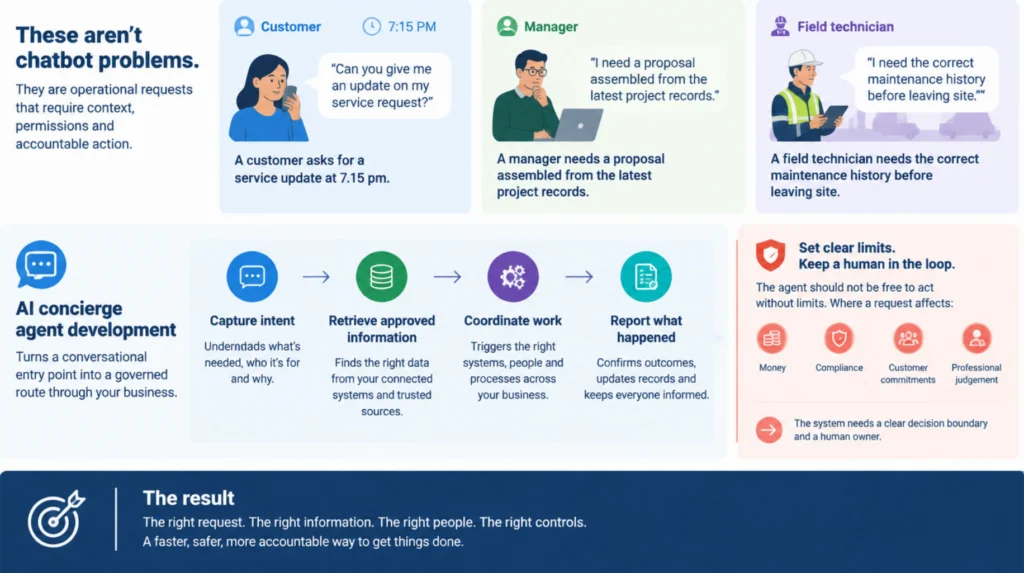
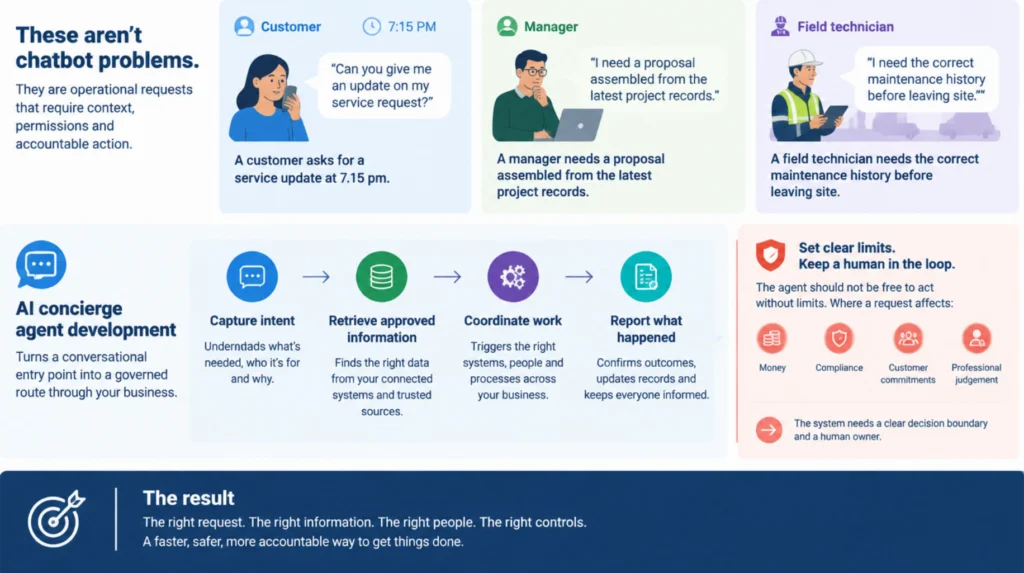
A customer asks for a service update at 7.15 pm. A manager needs a proposal assembled from the latest project records. A field technician needs the correct maintenance history before leaving site. These are not chatbot problems. They are operational requests that require context, permissions and accountable action.
AI concierge agent development turns a conversational entry point into a governed route through your business. The agent can capture intent, retrieve approved information, coordinate work across connected systems and report what happened. But it should not be free to act without limits. Where a request affects money, compliance, customer commitments or professional judgement, the system needs a clear decision boundary and a human owner.
What an AI concierge agent actually does
A branded AI concierge is not simply a friendly interface over a language model. It is an operational layer that helps people get work moving. It can sit on your website, in a customer portal, within a team workspace or behind an internal service channel, then connect the conversation to the systems where work is recorded and completed.
A useful concierge follows a deliberate route. It receives a request, identifies the person and their authority, gathers the relevant context, checks the applicable policy, takes permitted action or seeks approval, then records an evidence trail. The conversation is the front door. Orchestration is the operating system behind it.
For a professional services firm, this might mean preparing a client matter brief from approved documents, identifying missing information and routing the draft to the responsible adviser. For a field service business, it could confirm appointment windows, retrieve asset history, create a work order and escalate an exception to the dispatcher. In healthcare administration, it may help a patient complete a non-clinical intake process while keeping clinical decisions with authorised staff.
The distinction matters because a concierge agent that can only answer questions creates limited capacity. One that can safely coordinate a defined process reduces handoffs, waiting time and repeated administration.
AI concierge agent development starts with the route
The strongest builds do not begin by selecting a model or writing prompts. They begin with workflow mapping. Before an agent is given access to a CRM, ERP, inbox or document repository, the business needs to define how work currently moves and where it fails.
That usually exposes familiar friction: enquiries copied between inboxes, staff searching across disconnected records, requests that wait for an unavailable person, approvals buried in email, and no reliable way to see why a decision was made. These are not minor inconveniences. They consume capacity and make service quality dependent on individual memory.
A practical design asks several direct questions. What types of request can the agent handle? What information does it need to make a useful recommendation? Which system is the source of truth? What action can occur automatically, and what action must stop for approval? What evidence must be retained?
The answers establish the route. They also prevent a common failure mode: deploying an impressive demonstration that cannot be trusted in day-to-day operations.
Context must be current, relevant and permitted
An agent cannot coordinate effectively from a static knowledge base alone. It needs controlled access to live operational context, such as account status, open jobs, contract terms, appointment availability, case records or current stock information.
That access should be deliberate. Model Context Protocol, or MCP, can provide a structured way for AI systems to use approved tools and data sources. Rather than relying on a vague instruction to “check the CRM”, the agent can call a defined capability with scoped permissions and return a recorded result.
More data is not automatically better. A concierge should receive the minimum context needed for the task. A customer service agent may need to see an active order and its delivery status, but not confidential finance notes. A project coordinator may need a proposal template and approved project information, but not unrestricted access to every document in the organisation.
This is where identity and role-based access are part of the design, not an afterthought.
Decision boundaries create trust
The central question is not whether the agent can perform an action. It is whether it should.
Some actions are low risk and can be automated within policy: answering approved FAQs, booking an available slot, creating a standard ticket, sending a templated acknowledgement or retrieving a permitted status update. Other actions require review: offering a non-standard discount, changing a contract condition, releasing sensitive records, approving expenditure or giving advice that carries regulatory or professional consequences.
LET’S BUILD WHAT’S NEXT
Make your next move
an intelligent one.
Tell us where the bottlenecks are. Let’s explore what AI can do for your business.
A well-designed concierge recognises the difference. It can prepare the relevant information, explain the exception and route it to the correct person with a recommended next step. The human does not need to reconstruct the entire request from scratch. They retain authority where it matters.
This is not a compromise that slows the system down. In many organisations, it is what makes adoption possible. Staff are more likely to use an agent when they can see its boundaries, correct its output and understand who owns the final decision.
Designing the operating controls
Governance becomes real in the workflow, not in a policy document stored somewhere nobody checks. Each meaningful action should have a control appropriate to its risk.
For example, a concierge receiving a request to amend a customer booking could verify the requester’s identity, check the booking rules, confirm availability, make the change if it falls within policy and write the outcome back to the booking system. If the request falls outside the permitted window, it can present the available options and seek a team member’s approval before proceeding.
The record should show what the agent received, which systems it consulted, what policy it applied, what action was proposed, who approved it where required and what was ultimately completed. This evidence is useful for audits, dispute resolution, quality improvement and operational learning. It also makes failures diagnosable.
Controls should be proportionate. Requiring approval for every routine action simply recreates the bottleneck you intended to remove. Allowing broad autonomy for high-impact actions creates a different and more serious risk. The right threshold depends on your industry, customer commitments, data sensitivity and tolerance for error.
Where concierge agents produce measurable capacity
The best use cases are repetitive enough to benefit from coordination, but variable enough that a fixed form or basic automation struggles. They often involve multiple systems, unstructured requests and a predictable set of policies.
In field service, a concierge can qualify an enquiry, identify the site and asset, check technician availability, create a job, assemble the service history and alert a dispatcher when access requirements or safety conditions need review. The gain is not merely faster booking. It is fewer incomplete work orders and less time spent chasing context.
In healthcare administration, an agent can answer approved administrative questions, guide referral intake, identify missing documents, coordinate appointment options and route exceptions to the right staff member. It should not impersonate clinical judgement. Clear separation between administrative support and clinical decision-making is essential.
In professional services, the agent can turn a client request into a structured intake, locate approved precedents, generate a first-draft briefing pack and create tasks for the responsible team. It can also identify where conflicts, engagement terms or advice requirements mean the matter must pause for review.
The metric should reflect the route being improved. Measure response time, first-contact resolution, avoided manual touches, completion time, rework, approval turnaround or revenue leakage. Do not rely on conversation volume alone. A busy agent that creates more exceptions or poor-quality records is not adding capacity.
Build for exceptions, not the happy path
Most demonstrations show a clean request and a perfect answer. Operations rarely behave that way. Customers provide incomplete information. Records conflict. Policies have exceptions. A supplier changes a date. A staff member needs to override the recommended path for a legitimate reason.
AI concierge agent development should treat these situations as core design inputs. The agent needs a safe fallback when it lacks confidence, cannot access a required system, detects inconsistent data or receives a request outside its remit. It should say what it needs, route the work to the appropriate owner and preserve the context already collected.
This is also where multi-agent design can be useful. A primary concierge may coordinate specialised agents for document retrieval, scheduling, policy checking or task creation. Yet adding agents does not automatically improve a solution. More components can create more failure points and harder-to-follow handoffs. Use them where responsibilities are genuinely distinct and the orchestration remains inspectable.
A sensible path from pilot to operations
Start with one high-volume, bounded workflow where the business can define a meaningful baseline. Connect only the systems required to complete that route. Test the agent against real examples, including awkward requests and exceptions, before expanding its permissions.
Early operation should include active review. Watch where the agent asks for clarification, where approvals are frequent, where source data is unreliable and where people override its recommendation. Those signals are not evidence that the project has failed. They show where the workflow, policy or data needs attention.
Once the route is stable, extend it carefully. Add adjacent request types, improve the evidence captured and adjust autonomy only when the operating data supports it. SpeedOz approaches this as accountable orchestration: one conversation can trigger connected action, but every consequential step has an owner, a boundary and a record.
The practical goal is not an agent that appears clever. It is a dependable front door to work that your people can supervise, your customers can trust and your business can improve over time.