

A field service coordinator receives an urgent maintenance request at 4.45 pm. An AI agent can read the email, identify the site, check the service contract, find an available technician and prepare a customer reply in seconds. It should not, however, approve a costly after-hours call-out, promise work outside contract terms or alter a customer record without the right person seeing the basis for that action. That is where human approval workflows for AI become operational infrastructure, not a compliance add-on.
The goal is not to put a person back into every automated task. It is to define where authority sits, what evidence a person needs to exercise it, and what the system may do before and after approval. Done well, approval workflows protect judgement while removing the administrative drag around it.
Why AI needs decision boundaries
AI systems can classify requests, assemble information, draft communications, recommend next actions and coordinate work across disconnected applications. Those capabilities create value when they shorten slow hand-offs and reduce repetitive effort. They also create risk when an inferred answer is treated as an authorised decision.
The distinction matters most at consequential boundaries. A recommendation to approve a credit, reschedule a clinical appointment, issue a refund, change a project scope or dispatch a technician can affect revenue, safety, customer trust and contractual obligations. The AI may prepare the decision. A nominated person remains accountable for making it.
A useful operating rule is simple: automate preparation, route authority, record the outcome. This gives teams a practical answer to a difficult question: where should the system stop and a person take responsibility?
Human approval workflows for AI are routes, not inboxes
Many businesses treat approval as an email waiting for a reply. That approach quickly fails at volume. Requests lack context, approvers cannot tell what changed, reminders are inconsistent and no reliable record exists after the fact.
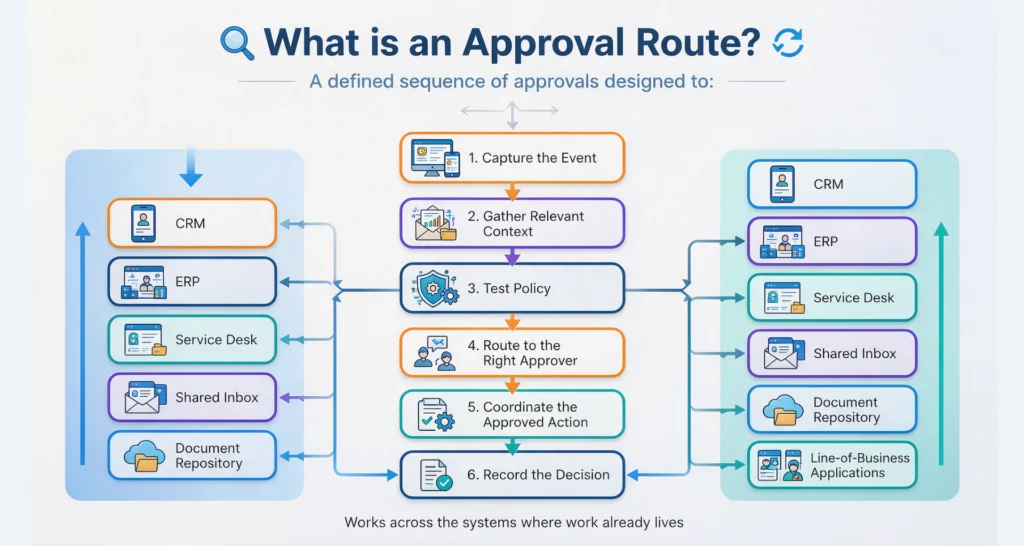
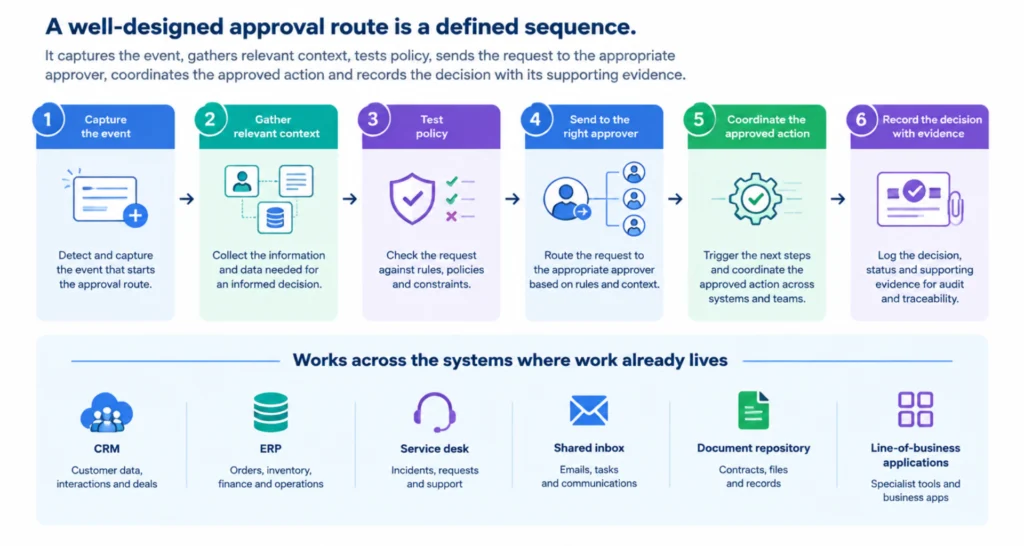
A well-designed approval route is a defined sequence. It captures the event, gathers relevant context, tests policy, sends the request to the appropriate approver, coordinates the approved action and records the decision with its supporting evidence. The route should work across the systems where work already lives: CRM, ERP, service desk, shared inbox, document repository and line-of-business applications.
Consider a professional services firm preparing a statement of work. An AI agent can assemble the client history, identify agreed rates, compare the proposed scope with the engagement letter and flag terms that depart from policy. If the terms are standard and fall below a delegated value threshold, the system may send the document for a director’s approval. If the scope includes new liability language, it routes to legal review instead. The human does not need to reconstruct the file. They see the proposed action, the exceptions and the source evidence.
That is materially different from asking a generic chatbot, “Can I send this?” The workflow knows the request type, the applicable policy, the approver’s role and the next permitted action.
The evidence an approver actually needs
Approvals become a bottleneck when people must hunt through systems to understand a request. They become careless when the screen provides only a vague summary and an Approve button. The approval record should make a decision possible without disguising uncertainty.
For most operational routes, the approver needs the request source, relevant customer or case context, the proposed action, policy checks performed, exceptions found, financial or service impact, confidence or ambiguity indicators, and the available choices. Those choices may include approve, reject, request changes, escalate or defer.
The system should also show what will happen after approval. “Approve” is not enough if it might send an external email, create a purchase order, update a contract and assign work simultaneously. Clear action previews reduce accidental commitments.
Set approval levels by consequence, not by fear
Putting every AI action through human review removes most of the capacity benefit. Allowing every action to proceed automatically turns small errors into fast-moving operational problems. The sensible position is risk-based autonomy.
Low-consequence actions can often proceed automatically within explicit rules. Examples include categorising inbound enquiries, drafting internal notes, extracting fields from standard forms or sending an acknowledgement that does not create a commitment. These actions still need logging and exception handling, but not necessarily a human click.
Medium-consequence actions usually warrant approval when the AI is acting externally or updating a meaningful business record. A customer-facing response that includes a delivery estimate, a proposed appointment change or a non-standard billing adjustment sits in this category. The approver should receive a concise, evidence-backed request.
High-consequence actions require stronger controls. These include releasing payments, approving clinical or employment decisions, accepting material contractual obligations, changing security permissions or closing a safety-related incident. The workflow may require a specific role, dual approval, separation of duties or a mandatory review of original documents.
Thresholds should reflect the organisation’s actual risk appetite. A $2,000 expense may be routine for one business and material for another. Likewise, a healthcare administration process may need a tighter approval boundary than a comparable scheduling workflow in a trade business. There is no universal approval matrix worth copying blindly.
Design the route around exceptions
Routine work should move quickly. Exceptions deserve attention. This principle prevents the most common failure in AI workflow design: applying the same level of scrutiny to every request, regardless of context.
Start by mapping the normal path and identifying the facts that should change it. For a field service request, the exceptions might be an expired contract, a site access restriction, a safety flag, an estimated cost beyond the delegated limit or a customer with unresolved overdue invoices. For healthcare administration, they may include missing consent, incomplete referral details or a mismatch between patient information across systems.
The AI can detect and present these conditions, but it should not invent a policy response. Policy belongs in explicit rules and governed instructions. Where the system is unsure, it needs a defined escalation route rather than a confident guess.
This is also where identity matters. The request must go to a person with the correct authority, not merely the person who happens to be available. Role-based routing, delegated authority and absence cover should be part of the workflow design from the outset.
LET’S BUILD WHAT’S NEXT
Make your next move
an intelligent one.
Tell us where the bottlenecks are. Let’s explore what AI can do for your business.
Make approvals inspectable after the moment has passed
An approval has value beyond the immediate decision. It creates evidence for customer queries, internal reviews, audits, incident investigations and process improvement. If a team cannot answer who approved an action, what they saw and which policy applied, it does not have a governable process.
Each route should retain an event trail. At minimum, record the incoming trigger, information retrieved, rules evaluated, AI recommendation, approver identity, decision, timestamp, final action and any subsequent changes. Keep references to source records so that evidence can be checked without relying on a generated summary alone.
This record also makes optimisation possible. Operations leaders can see where requests stall, which exceptions recur, how often recommendations are overridden and whether approval rules are too broad or too restrictive. A high override rate may reveal weak instructions, poor source data or a policy that has not kept pace with how the business operates.
Build for the systems people already use
Approval workflows fail when they become another destination employees must remember to check. The best route is often the one that brings a structured decision into the environment where the authorised person already works, while keeping the central evidence trail intact.
That may mean a manager receives an approval request in a collaboration tool, a service leader acts from the service desk, or a finance approver reviews an exception alongside the ERP record. The delivery channel matters less than the controls behind it. The system needs authenticated identity, clear permissions, complete context and a reliable return path to the source application.
Modern orchestration can connect these systems through APIs, workflow platforms and MCP server integrations. The technical design should not lead the conversation, though. Begin with the operating route: what starts the work, what evidence is needed, who owns the decision, what can be automated and what proves the outcome.
Test failure paths before expanding autonomy
A pilot that only tests clean, standard requests is not a meaningful test. Teams need to see what happens when a source system is unavailable, data conflicts, an approver is away, a request exceeds a threshold or the AI cannot classify the case with enough confidence.
Start with one high-volume workflow that has clear rules and measurable friction. Establish a baseline for turnaround time, rework, escalation rate and staff effort. Run the AI in recommendation mode first where appropriate, then expand to approved execution once the evidence and exception routes are working as intended.
Review decisions regularly, especially in the first weeks. This is not supervision for its own sake. It is how the organisation learns whether the policy, instructions, integrations and authority model reflect real operations.
The strongest AI systems do not ask people to surrender control. They make control easier to exercise at the exact moment it matters, with the evidence to act decisively and the route to prove why.