

A service coordinator asks an AI assistant to prepare a work order. The assistant needs the customer record, asset history, technician availability and pricing rules. It may also need permission before it changes a booking or sends a customer message. That is where model context protocol MCP server integration becomes operational infrastructure, not another chatbot feature.
MCP gives AI systems a standard way to request context and use approved tools. Done well, it reduces the brittle one-off connections that often slow automation projects. Done carelessly, it gives a language model an unclear path into systems it should not control. The difference is governance at the boundary.
What an MCP server changes
Most businesses already hold the information required to resolve work. It sits across a CRM, ERP, inbox, service desk, document repository and internal applications. Staff bridge those gaps manually: copying notes, checking fields, chasing approvals and updating multiple systems after the fact.
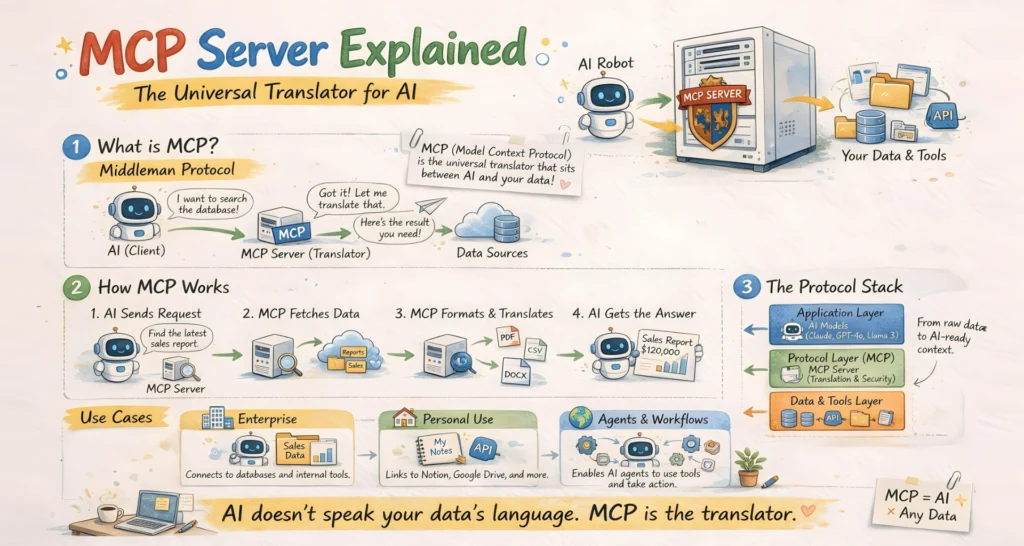
An MCP server exposes selected capabilities from those systems in a consistent format for an AI client or agent. A capability might be read-only, such as finding a customer, retrieving an open case or checking an equipment manual. It might also be an action, such as drafting a job, creating a service ticket or requesting approval for a credit.
The key word is selected. An MCP server should not be treated as a broad doorway to an entire business platform. It is a controlled route. The server defines what can be requested, what inputs are required, which identity is permitted to make the request and what evidence must be recorded.
This matters because an AI model can reason over a task, but it does not inherently know your operating policy. It cannot safely infer who can authorise a refund, whether a clinician must review a document, or whether a field technician has the right certification. Those rules belong in the operational system around the model.
Model context protocol MCP server integration needs boundaries
The technical connection is usually the easiest part. The harder work is deciding where an agent may look, what it may do and when it must stop for a person.
A useful design starts with a real workflow rather than a list of systems. Take a professional services firm handling a new client request. The route may be: capture the enquiry, identify the organisation, check for conflicts, locate the relevant engagement terms, prepare a response, obtain partner approval where required, create the matter and record the outcome.
MCP can connect the agent to each approved source or action along that route. But every step needs a boundary. The agent may search the CRM for an existing contact. It may summarise documents from an authorised repository. It may draft an engagement response. It should not approve a conflict check, accept contractual risk or create a binding agreement without the designated authority.
This separation improves more than compliance. It makes the workflow predictable. People know which work is automated, which work is assisted and which decisions remain theirs.
Read, recommend, act
A practical permission model distinguishes between three levels of capability.
At the read level, an agent retrieves only the context needed for the task. At the recommend level, it can classify, compare, draft or propose the next action. At the act level, it can write to a business system or trigger a downstream process.
Not every use case needs the third level. In healthcare administration, an agent may safely assemble referral information and flag missing documentation, while a trained staff member confirms the final record. In field service, it may propose the best appointment window, but a scheduler approves changes that affect a priority customer or contracted response time.
The right level depends on consequence, not novelty. A low-value internal status update may be fully automated. A decision that changes customer commitments, financial exposure, safety or professional accountability should have a clear approval route.
Build for identity and evidence
MCP does not remove the need for access control. It makes access control more consequential because an AI system can use tools at speed and across multiple systems.
Each MCP server should operate with a defined identity model. That includes the identity of the user or service initiating the request, the identity used to access the connected platform and the scopes granted to the server. Permissions should be narrow, time-bound where possible and separated between environments. A development agent should not have a path to live customer records simply because a connection was convenient during testing.
Inputs also need validation. If an agent is allowed to create a job, the server should validate customer IDs, required fields, dates, service locations and permitted job types before writing anything. Business rules should be enforced by the server or source system, not left to model instructions alone.
Evidence is the other half of control. For consequential actions, retain the request, the context sources used, the rule or policy checked, the approval outcome, the action performed and the resulting record ID. This is not about producing a transcript of every model thought. It is about making the operating route inspectable.
When a manager asks why a booking moved, why a case was escalated or why a customer received a particular response, the team should be able to answer with facts. What data was used? Which rule applied? Who approved it? What changed?
Start with a narrow workflow
Businesses often begin by connecting every available system and then asking what the AI can do. That approach produces a wide surface area, unclear ownership and difficult testing. Start with one workflow that is frequent, bounded and measurable instead.
Good candidates have repetitive information gathering, known decision rules and clear hand-offs. Examples include triaging service requests, preparing client onboarding packs, checking invoice exceptions or coordinating routine maintenance follow-up.
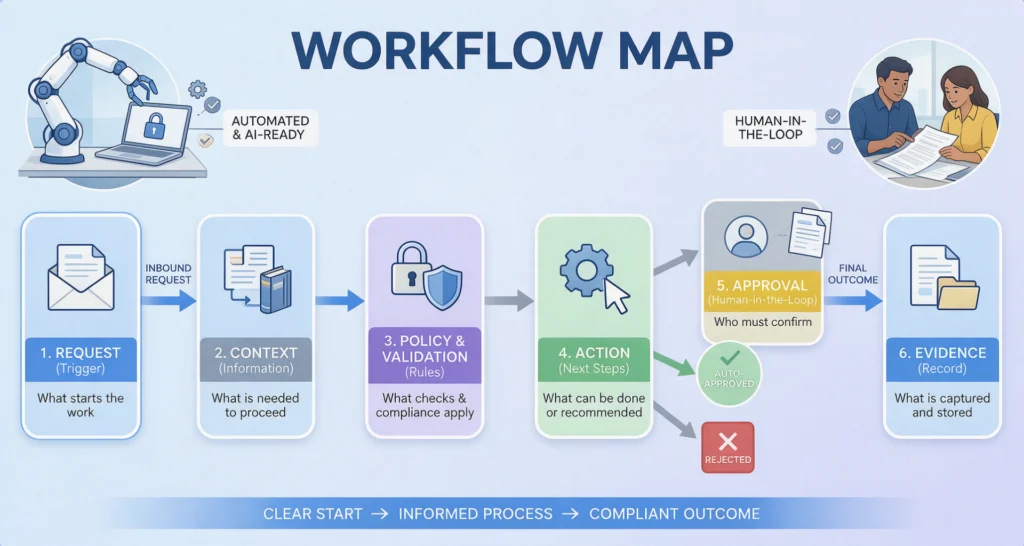
For each workflow, map six elements:
- the request that starts the work
- the context required to resolve it
- the policies and validation checks that apply
- the action the agent can take or recommend
- the human approval point, if one is required
- the evidence captured at completion
That map becomes the design brief for MCP servers, orchestration logic and agent instructions. It also exposes gaps in the underlying process. If no one can agree who owns an exception today, an AI implementation will not solve the ambiguity. It will reveal it faster.
Integration patterns that hold up in operations
A single agent with unrestricted access is rarely the best production design. A more reliable pattern uses an orchestrator to coordinate specialised actions. One component interprets the request, approved MCP servers retrieve context, policy checks assess the proposed route, and a human receives an approval request when the threshold is met.
For example, an accounts team may use an agent to handle invoice enquiries. The agent identifies the supplier and invoice, checks the ERP for status, retrieves supporting correspondence and drafts a response. If it identifies a duplicate payment risk, it does not process a correction. It creates an exception record with evidence and routes it to the finance owner.
This design is slightly slower than allowing the agent to act freely. It is also safer, easier to improve and much more acceptable to teams responsible for customers, cash flow and compliance.
Error handling deserves the same attention. External systems fail, data is incomplete and an agent may receive an ambiguous request. Define what happens when a tool call fails, a record cannot be matched or confidence is below the required threshold. In many cases, the correct action is not a second attempt. It is a clear escalation with the information already gathered.
Measure capacity, not demonstrations
An MCP integration is worth keeping only if it improves an operating measure. That may be time to first response, jobs scheduled per coordinator, exception resolution time, documentation completeness, rework rate or service-level performance.
Measure a baseline before deployment. Then track both throughput and quality after the route is live. A faster process that creates corrections, unapproved commitments or staff distrust is not a gain.
Review real cases regularly. Look for tools that are rarely used, approvals that are routinely bypassed, repeated escalation causes and data sources that generate poor recommendations. These observations should feed back into permissions, policy logic and workflow design.
SpeedOz approaches MCP as part of accountable orchestration: connected systems, clear boundaries and evidence at each consequential decision. The goal is not to let an AI agent roam across the business. It is to give it a defined job, the right context and a controlled way to move work forward.
The best first integration is rarely the flashiest one. It is the route where a team already knows the work is repetitive, the decision boundaries are visible and a better hand-off would create capacity immediately.